Deutsches Technikmuseum
(German Museum of Technology)
Berlin, Germany
February 2026
|
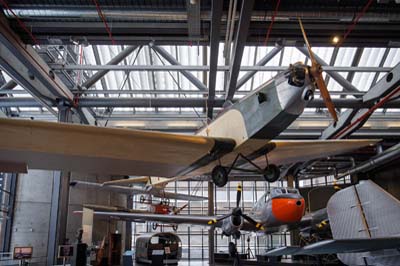
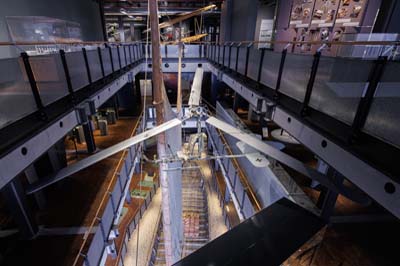
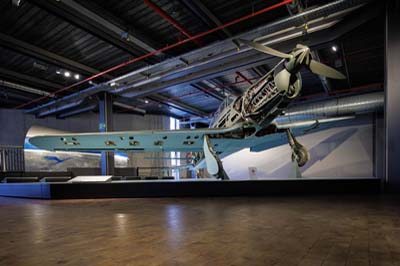
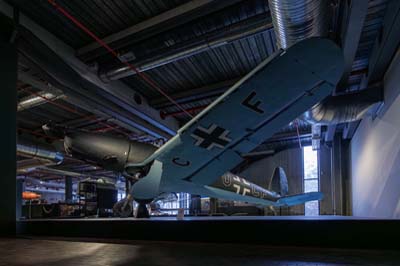
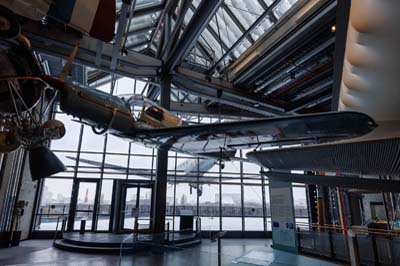
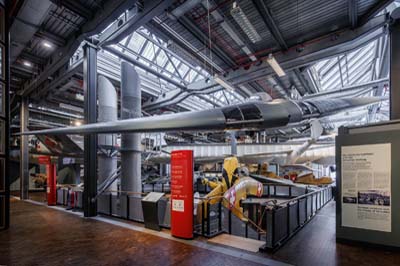
The Deutsches Technikmuseum, or German Museum of Technology, is located close to the centre of Berlin and housed in a modern multi floor building. The upper level contains the majority of the aviation collection, featuring many rare aircraft, most of them German built.
From a photographer's perspective, the display presents challenges. The aircraft are tightly arranged and often partially obscured by structural pillars, making clear compositions difficult. The museum also prohibits tripods, which can be frustrating in low light conditions.
With the vast hangar space at Tempelhof currently undergoing refurbishment, I believe there are plans to eventually relocate the aircraft to this more spacious and historically significant aviation setting, which would provide a far more fitting backdrop for the collection. |
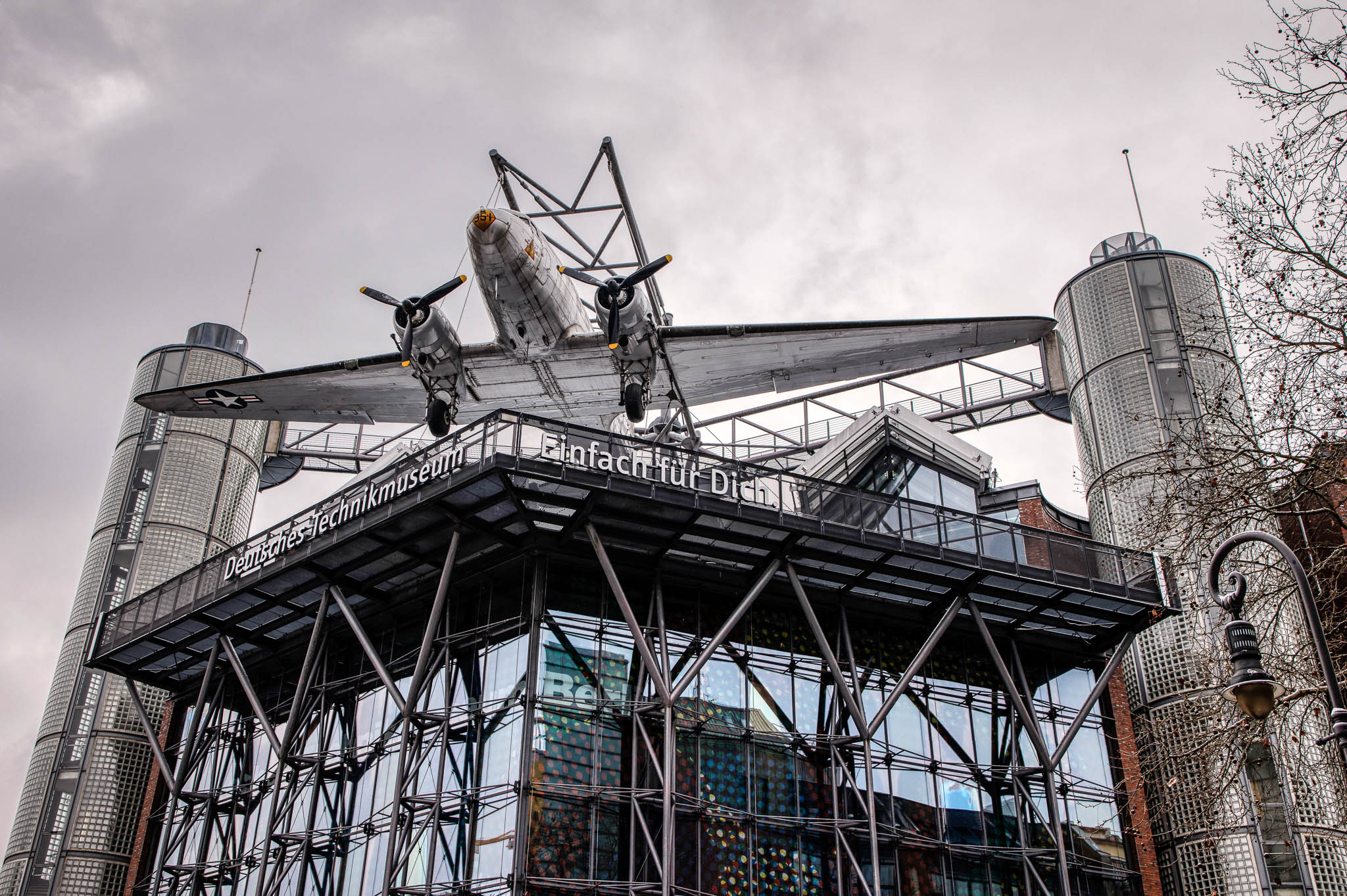
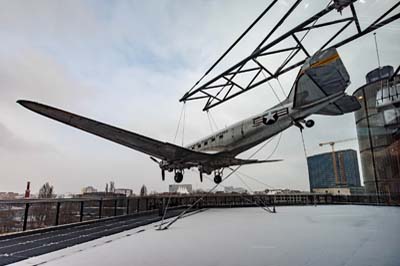
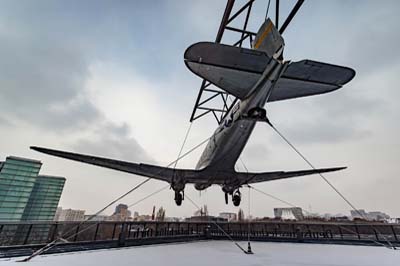
| Left to right: Douglas C-47B Dakota (45-0951) was built for the USAAF it was transferred to the Spanish Air Force as T.3-54 in June 1962. |
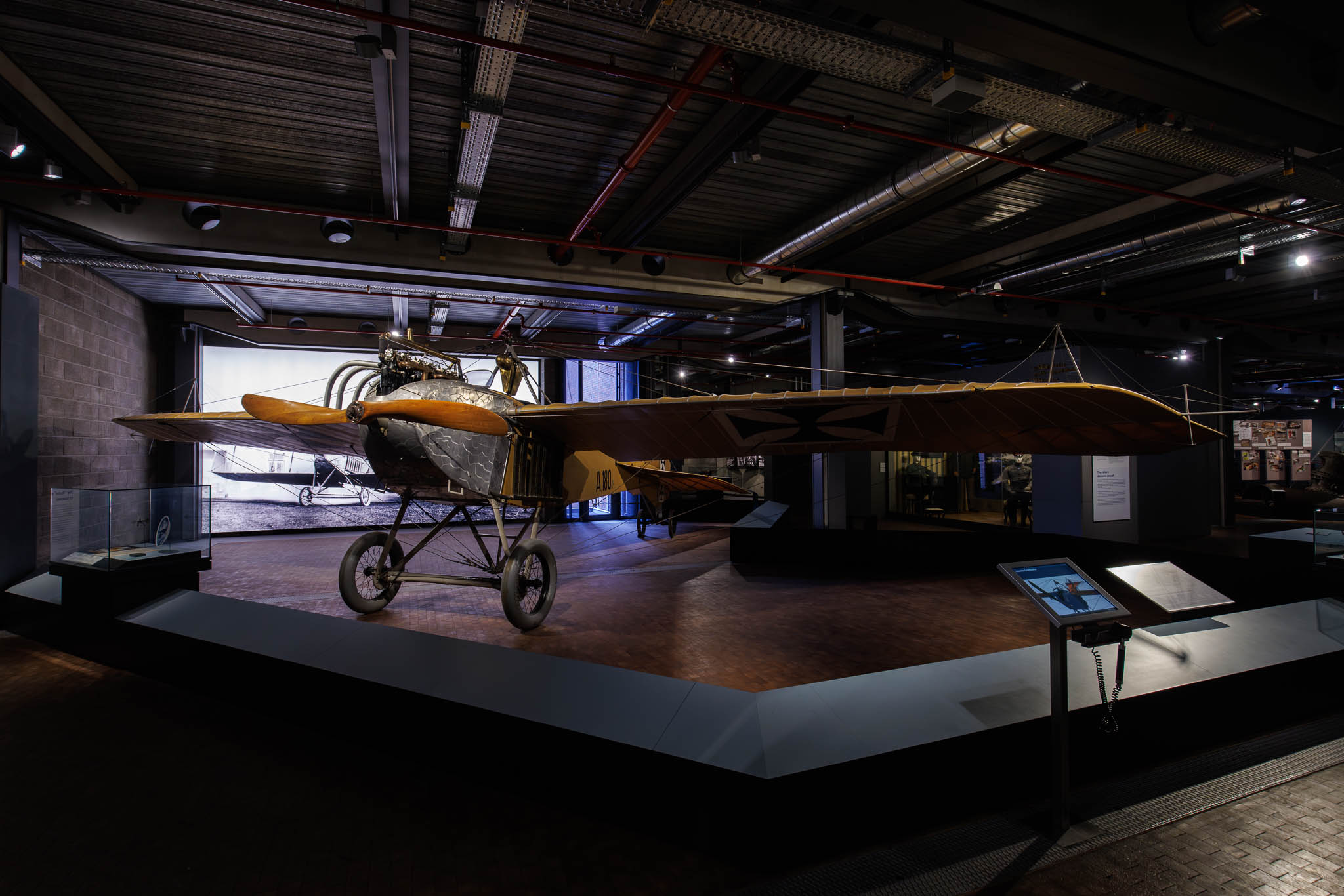 |
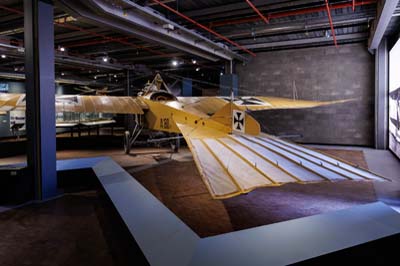
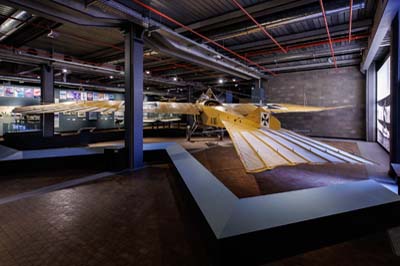
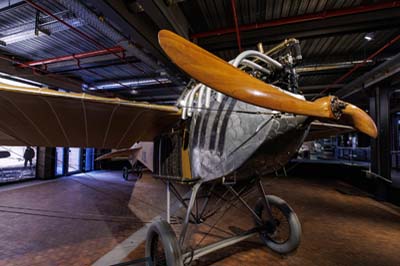
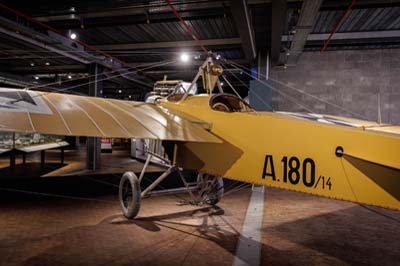
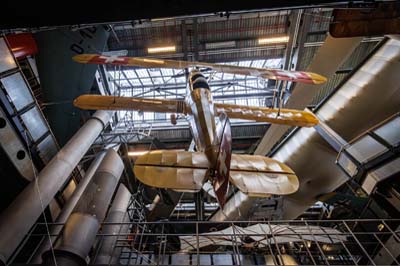
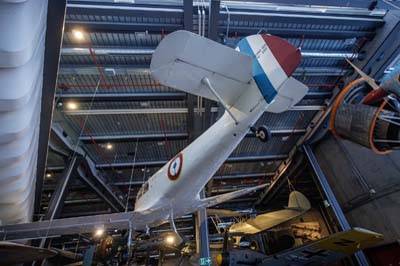
Left to right: Jeannin Stahltaub (Steel Dove) (A.180/14 c/n 76). The Taube was designed in 1909 by Igo Etrich of Austria-Hungary and first flew in 1910. The Jeannin Stahltaube was an improved version developed by Emil Jeannin with a robust steel tube fuselage, unusual for the era, warp controlled wings, and a 120 horsepower Argus As II engine, built by Deutsche Flugzeug Werke. Renowned for its stability, the Taube was used primarily for reconnaissance and training by the German Imperial Air Service at the start of World War One. Underpowered, sluggish, and unarmed, only a small number were built, but it saw operational use until mid 1915 before being placed in storage.
This only surviving aircraft, constructed in late summer or autumn 1914, was restored in 1986. It features a yellow orange rubberized finish inspired by similar pre-war designs, though its exact relevance to military service is unclear. The aircraft was unveiled at the museum in 1987. |
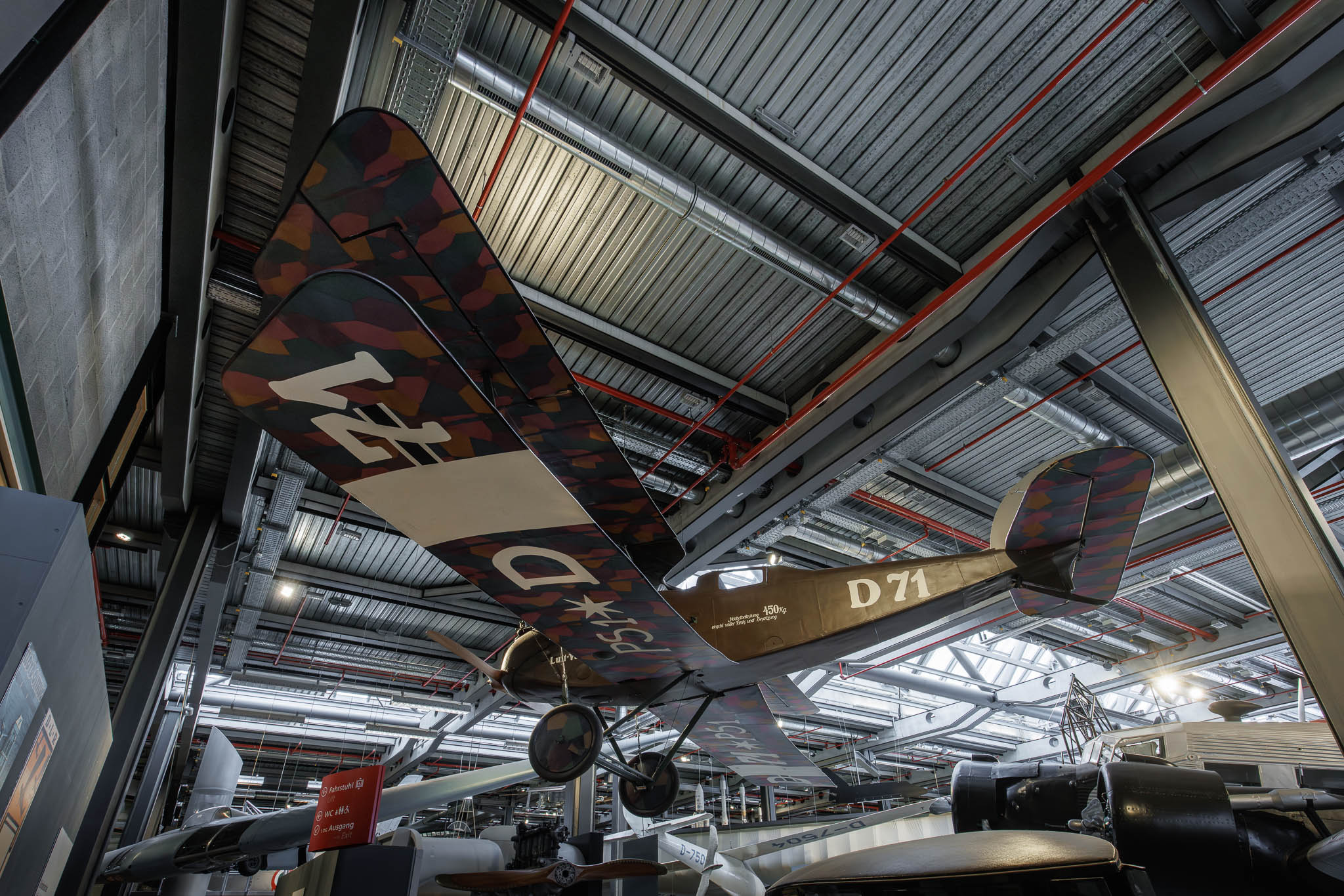 |
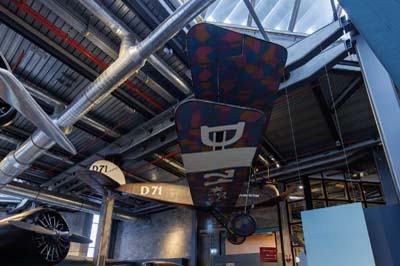
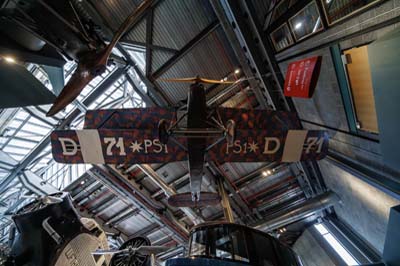
Left to right: Halberstadt CL.IV (D-71 c/n 1447). Following its service with the Imperial German Air Service in World War One it was one of three complete Halberstadt CL.IVs acquired from the Reparation Commission in 1920 by Paul Strähle (German aviation pioneer, fighter pilot and aerial photographer), it originally flew as a photo plane until September 25, 1938. Paul Strähle's archive of 40,000 aerial photos still exists today, along with the additional spare parts and three extra Halberstadt fuselages he saved that enabled four of these aircraft to survive, two in Berlin and two in the United States.
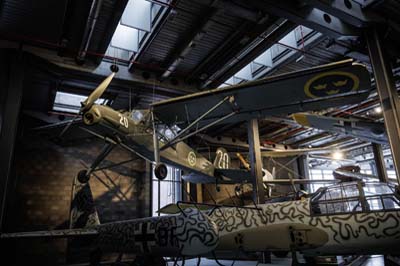
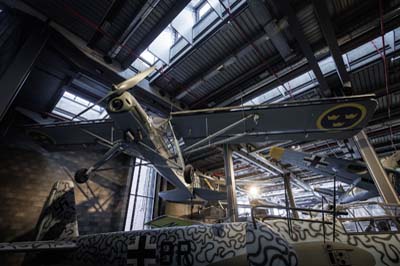
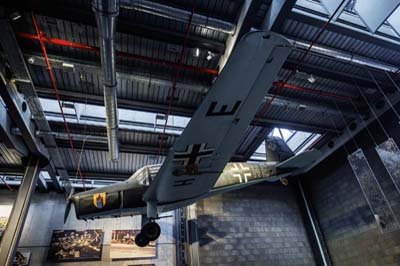
Focke-Wulf Fw 44J Stieglitz (Fv 669) ex Swedish Air Force. Designed in Germany as a two-seat trainer it flew for the first time in 1932. In 1935 they tested two German built aircraft and followed up with an order for 85 more to be built under licence in Sweden from 1937 by ASJA (AB Svenska Järnvägsverkstädernas Aeroplanavdelning), where it was designated Sk 12. ASJA was merged with Saab in 1939. The Sk 12 continued in service with the Swedish Air Force as a primary trainer until 1955. This example was transferred from the Kåremo Flygmuseum, Sweden. |
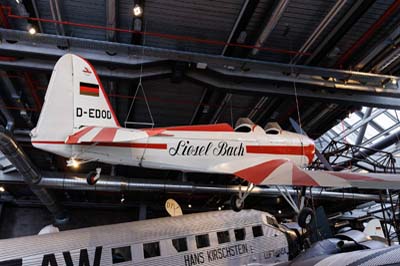
Left to right: Klemm Kl 35D (Sk 15A) (Fv 5028 registered SE-BPC, D-EDOD c/n 1917). The Klemm Kl 35 was a German sporting and training aircraft developed as the successor to the Kl 25 by Klemm Leichtflugzeugbau GmbH. Retaining the single engine, cantilever low wing layout of its predecessor, it introduced a distinctive inverted gull wing that set it apart visually and aerodynamically.
First displayed publicly at the International Air Show in Milan in October 1935, the Kl 35 was fully aerobatic. Development suffered an early setback when the prototype crashed during testing at Rechlin in 1935, but subsequent trials proved successful. In July 1936, an initial order for 23 aircraft was placed, with production increasing steadily. At the time, Klemm was also building the Focke Wulf Fw 44 under licence.
An improved version, the Kl 35D, appeared in 1938 as a Luftwaffe trainer. Powered by a 105 horsepower Hirth HM 504A 2 engine and capable of operating on wheels, skis, or floats, it was used extensively to train student pilots in aerobatics, navigation, and transition to faster military aircraft. Though not a combat aircraft, it played a vital role in preparing thousands of Luftwaffe pilots.
The Kl 35 became the most numerous Klemm design, with more than 3,000 built. The Swedish Air Force acquired several, designated Sk 15, including seaplane variants, and began licence production in 1941, building about 74 additional aircraft. Some remained in Swedish service until 1951. Today, only around 12 Kl 35s survive, most of them in Germany or Sweden.
This example, inscribed 'Liesel Bach' was built in 1940 for the Swedish Air Force as an Sk 15A. In 1949 it was registered SE-BPC. It arrived at the Deutsches Technikmuseum in September 2013.
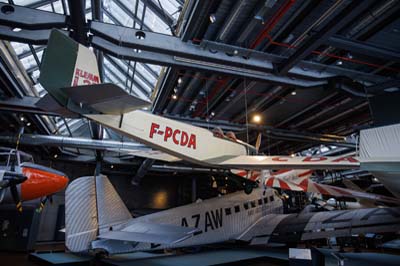
Klemm L 25b (F-PCDA, previously D-1611, TS-AAB, EZ-AAB). The Klemm L 25 was a light, single engine, two seat touring and training aircraft built by Leichtflugzeugbau Klemm GmbH in Germany. Produced in several variants, it became one of the company's most successful early designs. The aircraft was also built under licence in Britain by the British Klemm Aeroplane Company, later known as the British Aircraft Manufacturing Company, where it was marketed as the British Klemm Swallow and later the British Aircraft Swallow II.
It was previously on display at the Tempelhof Airport terminal before being moved to the Deutsches Technikmuseum.
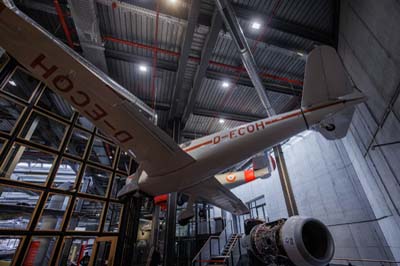
Klemm Kl 107C (D-ECOH). (D-ECOH). The Kl 107 is two-seat light aircraft developed in Germany in 1940. Production recommenced in 1955 with a modernised version, the Kl 107B and C. This example was built in 1960. |
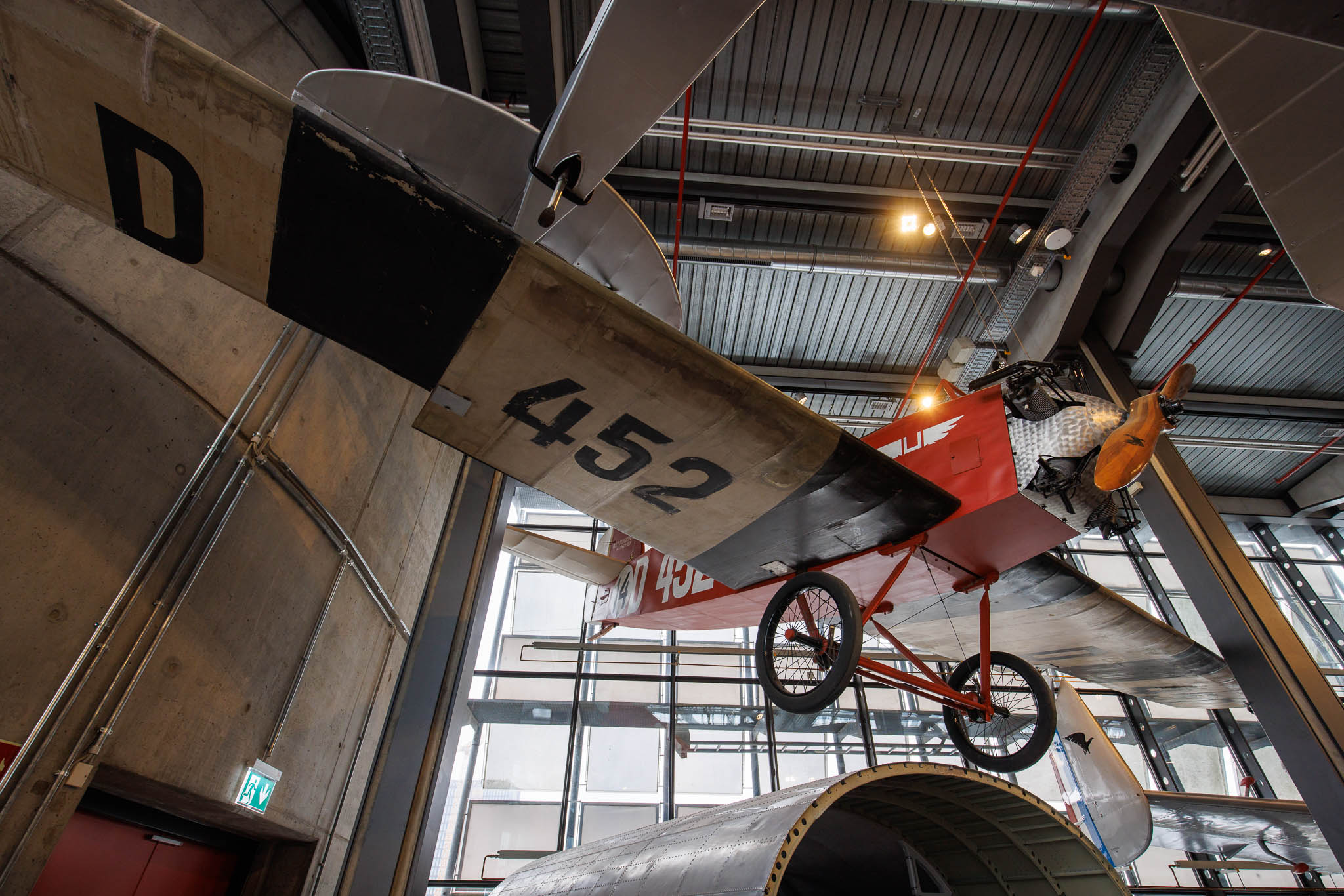 |
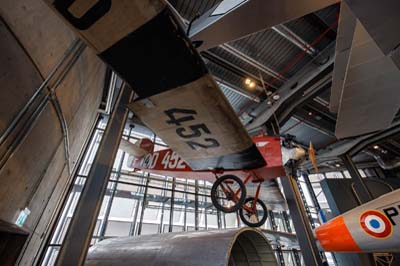
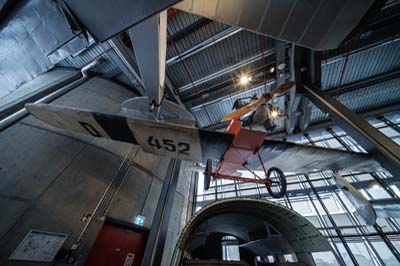
Left to right: Udet U 10 (D-452 '14'). Only eleven were built, with the first flight taking place in 1924. The aircraft on display is a replica reconstructed from a number of original components.
The two wings were rediscovered in 1972 at the former Army Museum of the GDR and entered the collection of the German Museum of Technology in the 1990s. After the museum acquired an original Sh 4 engine and a Schwarz propeller in Argentina, reconstruction began in late 2004. The fuselage is newly built from black pine using casein bonding, faithfully replicating the original construction methods. The landing gear combines original parts with newly manufactured components.
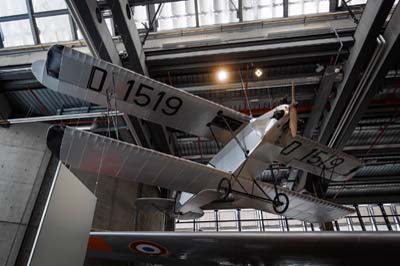
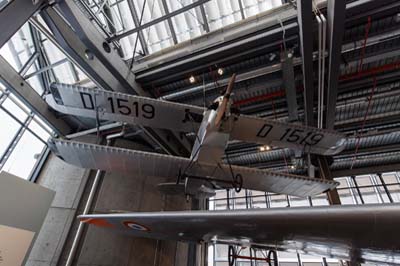
Raab-Katzenstein RK 9 Grasmücke (D-1519 c/n 353). In Germany, the RK 9 was operated mainly by flying clubs and private owners. After 1933, most examples were taken over by the German Air Sports Association, and by the mid 1930s these light aircraft had largely fallen out of favour and were withdrawn from regular use. In addition to a number of planned deliveries to China, three aircraft were exported to Switzerland, with a small number also finding their way to Argentina and Sweden.
D1519 was built in 1928 and is the only surviving RK 9 of the 28 examples constructed. Raab-Katzenstein Company went bankrupt in 1930. |
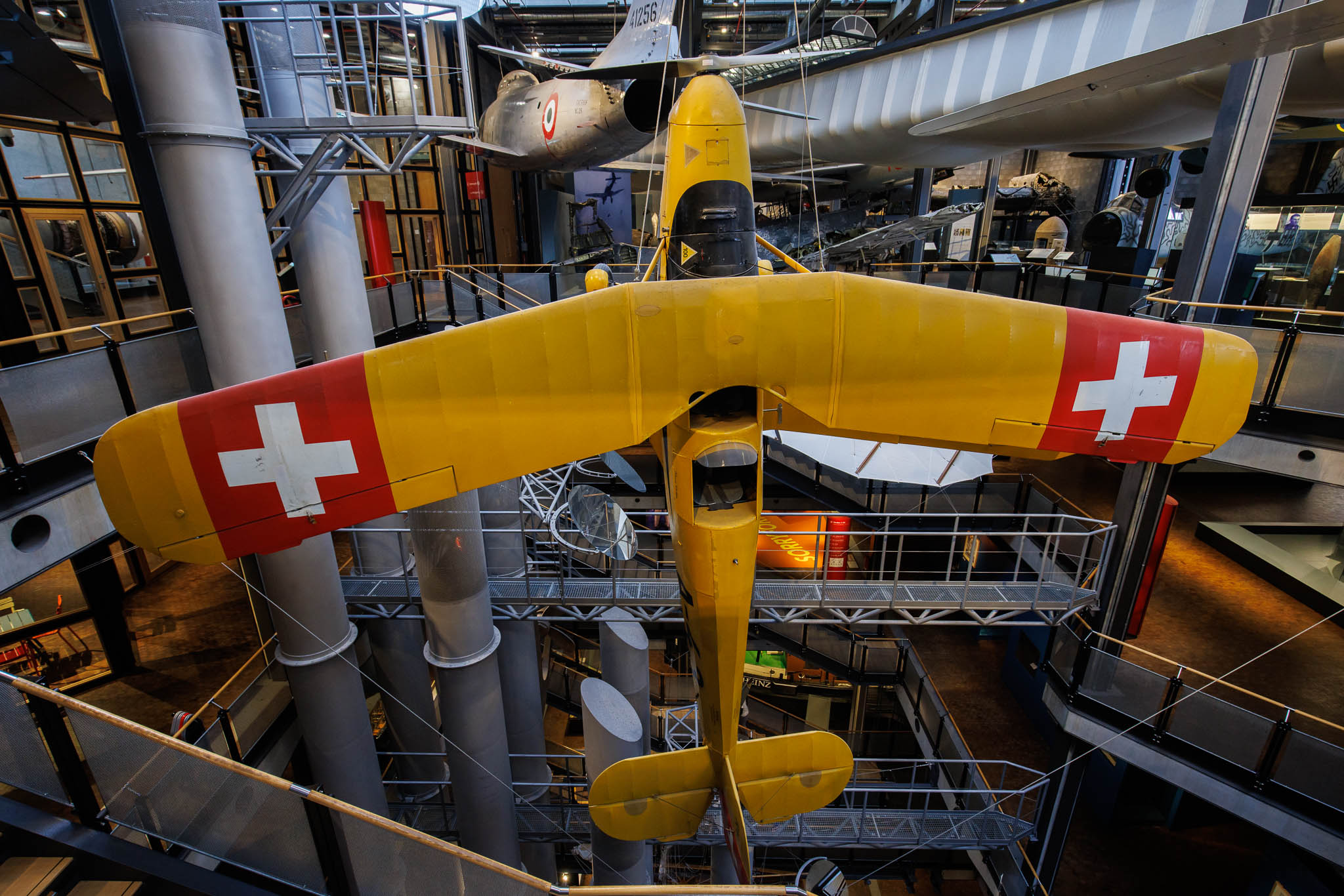 |
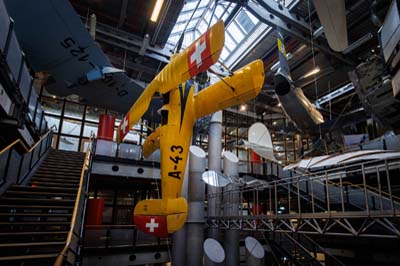
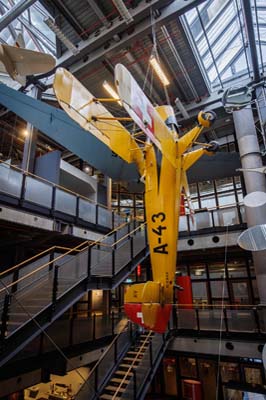
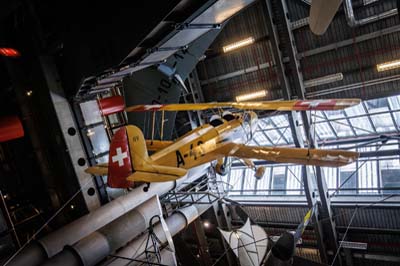
| Left to right: Bücker Bü 131B Jungmann (A-43 registered D-EBAD) ex Swiss Air Force. The Jungmann is a basic biplane trainer designed and produced by the German manufacturer Bücker Flugzeugbau. It was the company's first aircraft and the last biplane produced in Germany. Designed for aerobatic manoeuvres and pilot training, the Jungmann made its maiden flight on April 27, 1934. In 1936, production shifted to the improved Bü 131B, equipped with a more powerful Hirth 504A-2 engine. This model became the primary basic trainer for the German Luftwaffe. Several companies were licensed to produce the Bü 131, including Dornier, which built 88 of the 94 aircraft ultimately operated by Switzerland. |
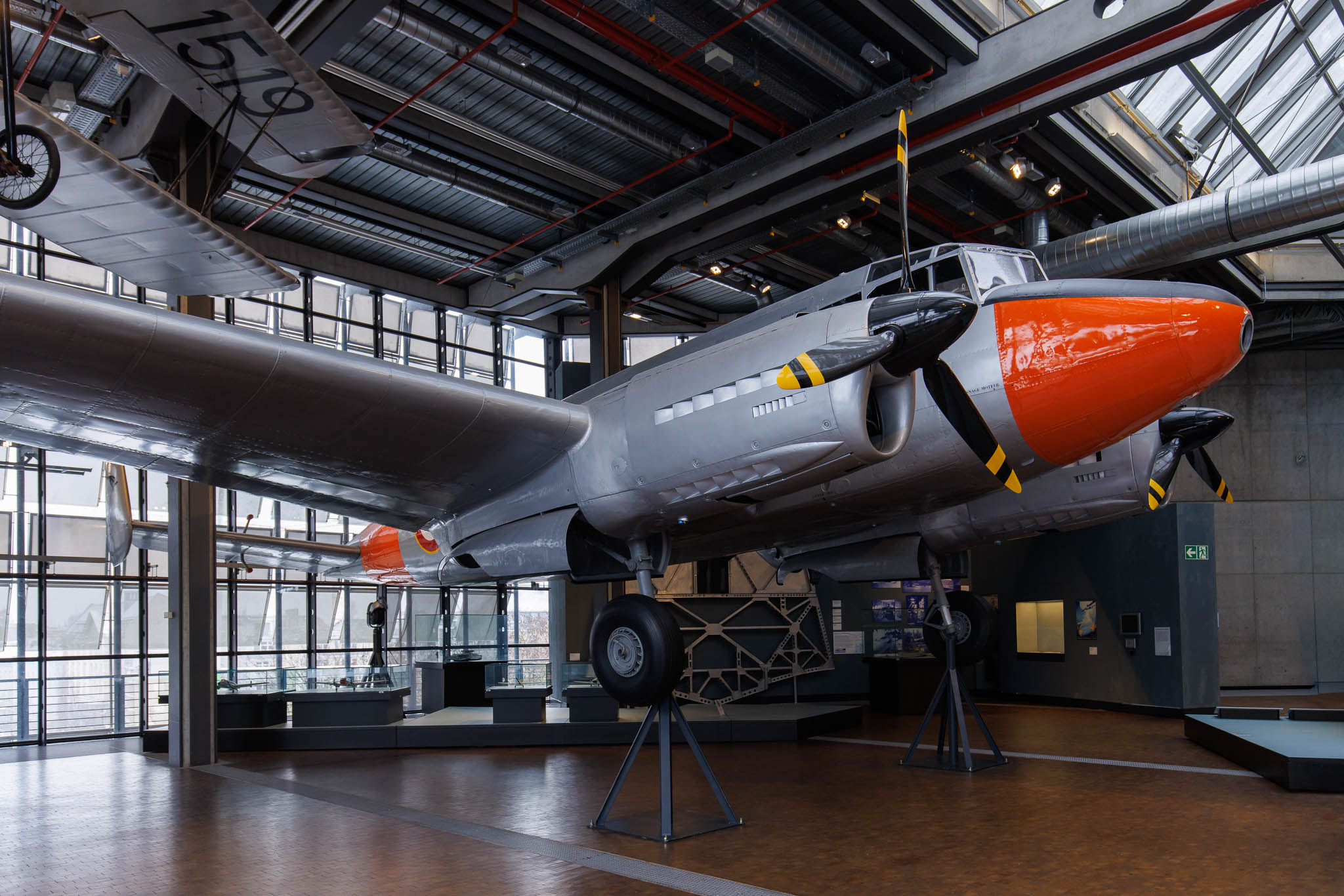 |
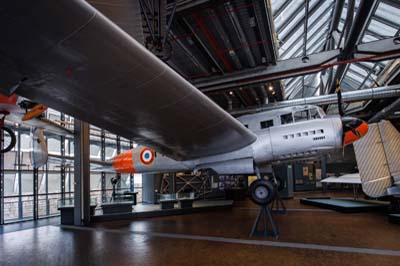
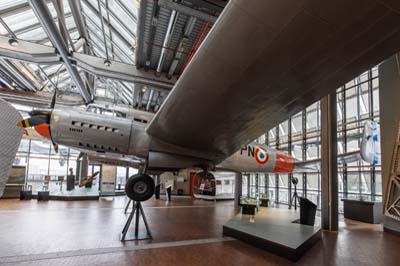
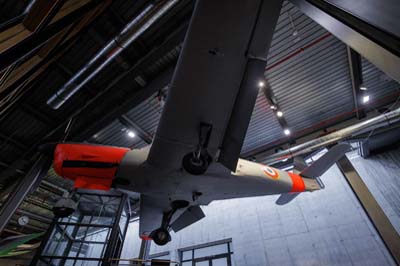
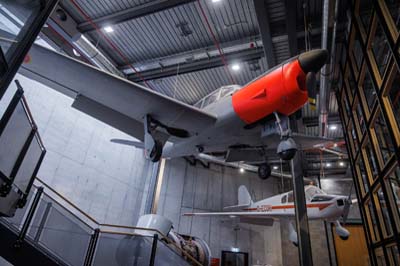
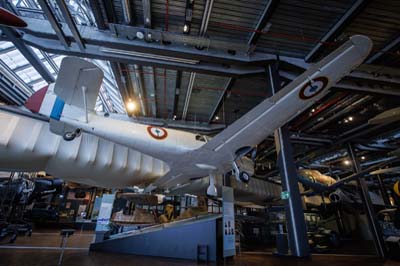
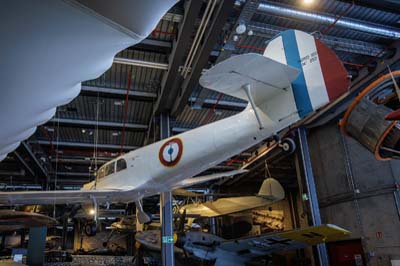
Left to right: Nord NC.702 Martinet (331 'PN') ex Armée de l'air (French Air Force). Built in 1949 by the Société Nationale de Constructions Aéronautiques du Centre (SNCAC), it was operated by the CEV at Bretigny from 1950 to 1969. It arrived at La Ferté-Alais, France in 1985 following time at a holiday camp in Avernes and I believe storage at Etampes (circa 1975). In 1998 it was transferred to Deutsches Technikmuseum and following restoration by Lufthansa at Frankfurt from 2003 it was put on display in 2006.
The Martinet was a German-designed (Siebel 204) but built in France by SNCAC (the Société Nationale de Constructions Aéronautiques du Centre) as twin-engine military trainer and light transport aircraft for the Armée de l'air and Aéronavale. 350 were constructed but only three remain preserved. La Ferté-Alais - August 1998.
Nord 1101 Noralpha (106) ex Armée de l'air (French Air Force). The Noralpha is a French-built and re-engined Messerschmitt Bf 108 Taifun produced by Nord Aviation. |
| Left to right: Nord N.1002 Pingouin (257) ex Armée de l'air (French Air Force). The Pingouin was a re-engined Messerschmitt Bf 108 Taifun, built by S.N.C.A.N. in France after the end of World War Two. |
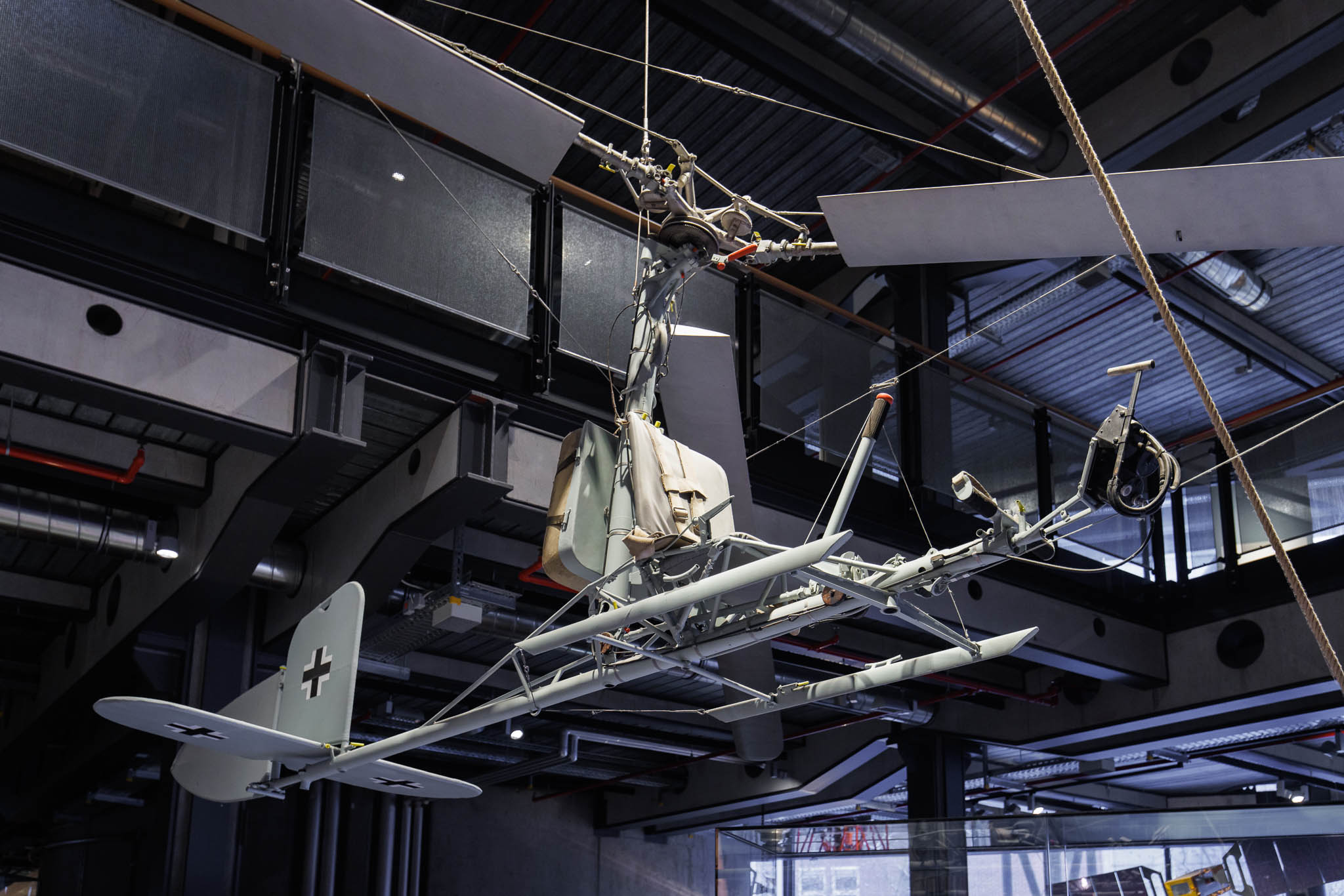
| Left to right: Focke-Achgelis Fa 330A-1 'Bachstelze' (100345). It was designed as an unpowered autogyro kite towed behind German Type IXD2 U boats to serve as an observation platform. The aircraft was designed by Heinrich Focke, with testing beginning in mid 1942. Operational deployment followed in early 1943, and around 200 examples were built by Weser Flugzeugbau. |
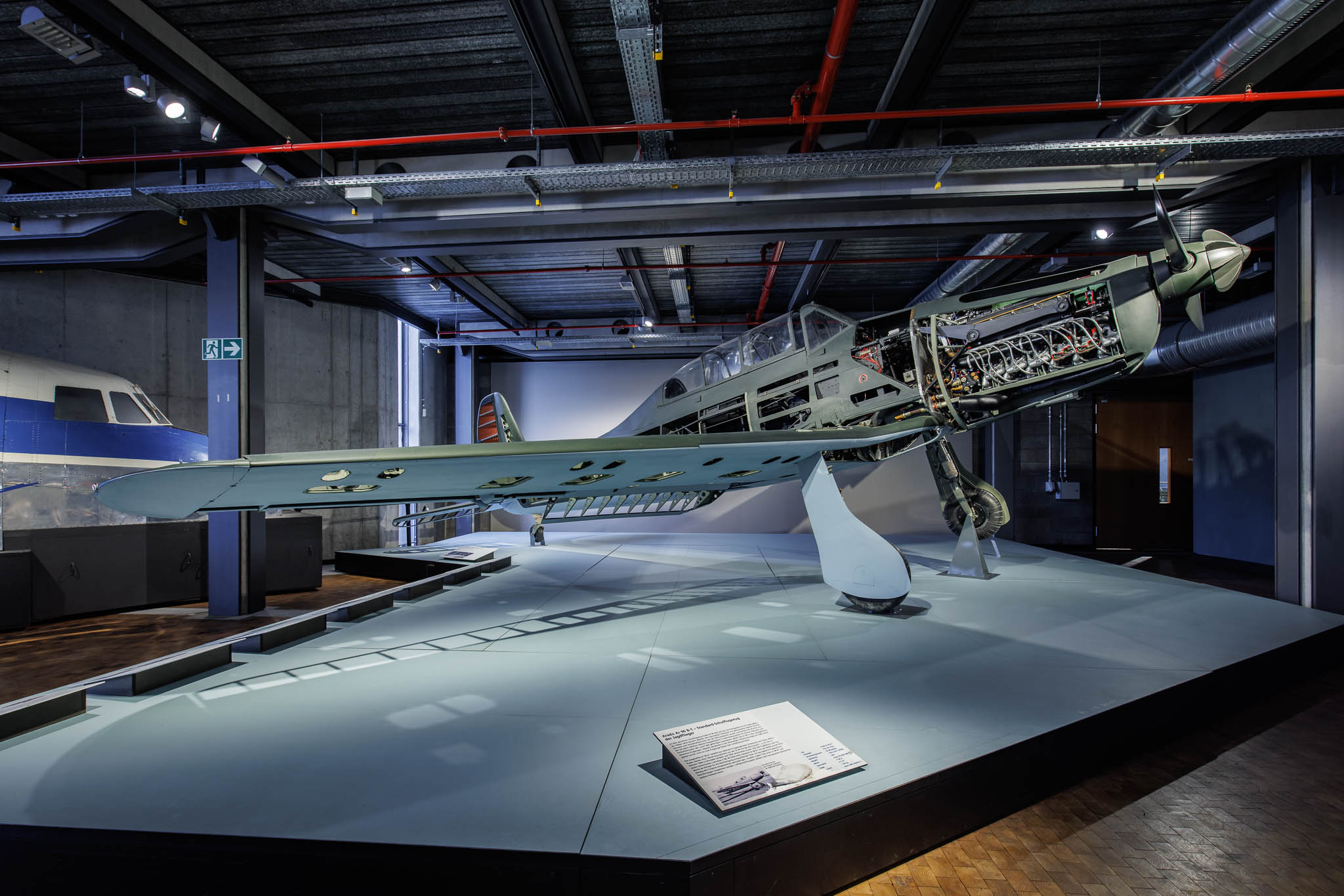 |
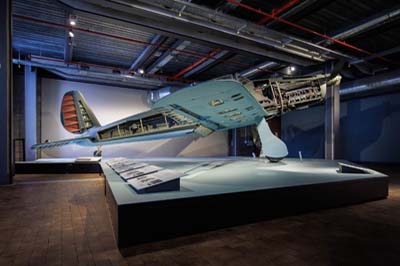
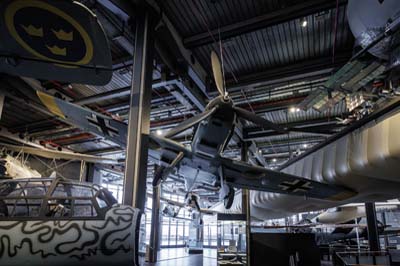
Left to right: Arado Ar 96B-1 (4081 'CH+DH registered SE-AOB marked as 'U+CF'). The Arado Ar 96 served as the Luftwaffe's principal advanced trainer throughout World War Two. The first prototype was completed in late 1936, followed by five improved prototypes. The first production batch of Ar 96A aircraft entered service in late 1939. German pilots typically progressed from basic biplane trainers to the Ar 96 for advanced, night, and instrument training.
Powered by an Argus engine, the Ar 96 was of all metal construction and featured a wide track undercarriage, hydraulically operated landing gear and flaps, and an automatic flap system that would deploy the flaps according to airspeed if the pilot failed to lower them. As the war progressed, Arado explored the use of lower grade metals and wood in an effort to simplify production, but the resulting Ar 296 and Ar 396 designs were not considered satisfactory.
In 1943, the French manufacturer Société Industrielle pour l'Aéronautique built 28 Ar 396 aircraft, designated SIPA S.10, and after the war continued producing both wooden and metal versions powered by Renault engines. In Czechoslovakia, Avia built 228 Ar 96B aircraft under the designation Avia C.2B, while Letov later produced a further 182 Ar 396 aircraft after the war. Across all variants, a total of 2,891 aircraft were built before March 1945.
The half cutaway aircraft on display is a composite example and is believed to be one of only two or three survivors. It is thought to be based around the remains of a German built Ar 96B flown by a defecting pilot to Sweden, where it later remained airworthy as a civilian aircraft during the 1950s. The restoration incorporated a range of recovered and newly manufactured parts, with the wings originating from a Czech built Avia C.2B. The fuselage was completed and displayed in 2006, with the wings finished and attached in 2010.
In Norway, the Flyhistorisk Museum at Sola has restored the fuselage of Ar 96B 4246, which was recovered from Lake Storvatnet in 1992 after crashing in 1943. Work has continued to complete the aircraft with the installation of an engine and restored wings. Another survivor is the incomplete fuselage of Ar 96B 4210, recovered from Lake Biscarosse in France in 1981. It remains preserved in private hands in Germany.
Arado Ar 79B ('VA+HP' registered D-EMVT c/n 47). Built in 1939, the Arado Ar 79 is a German two seat, low wing monoplane designed for aerobatic training and touring. Only 48 were produced, and this is the sole surviving example. Restored in 1996, the aircraft remained airworthy and flew until 2001. |
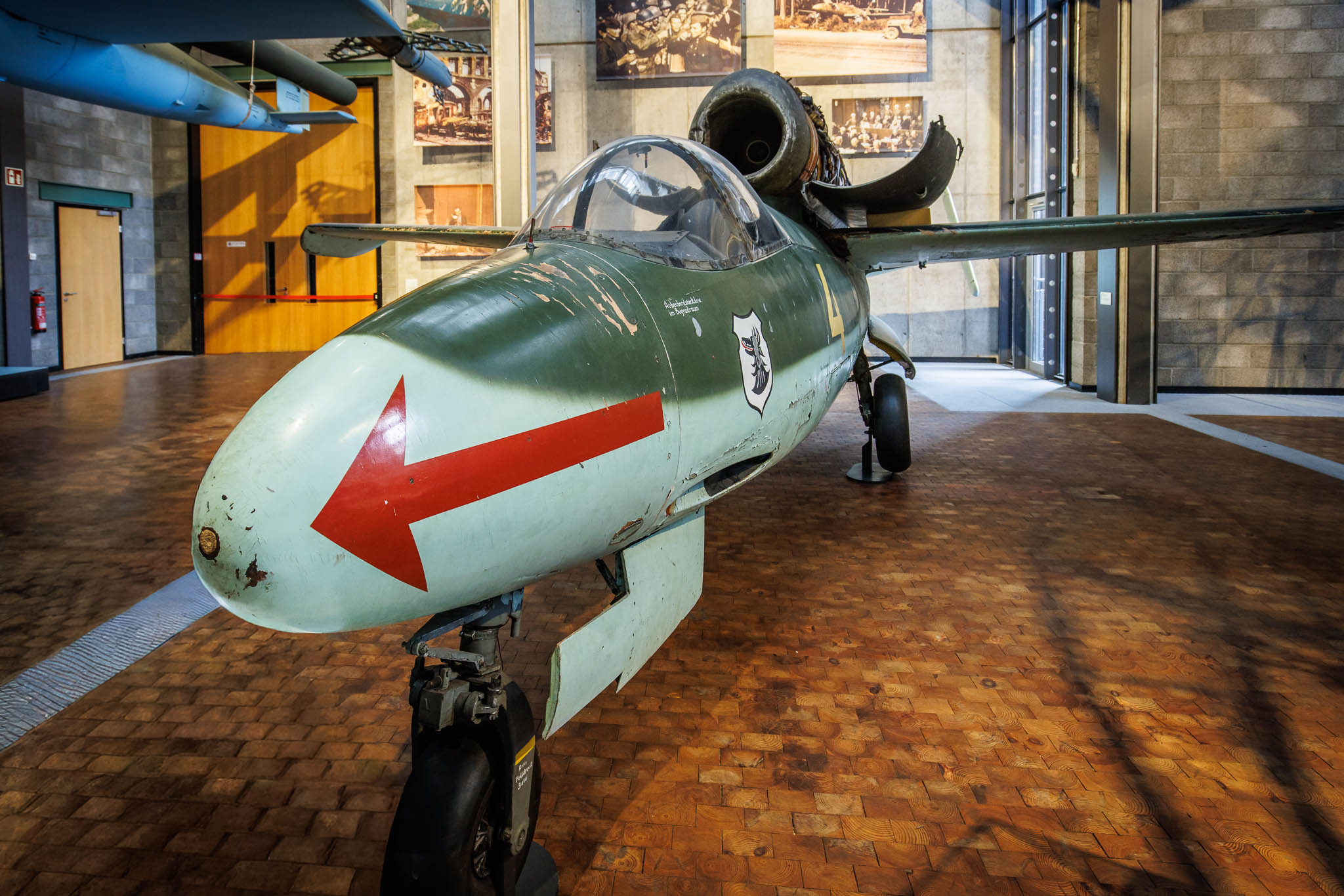 |
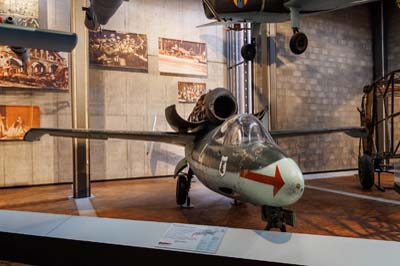
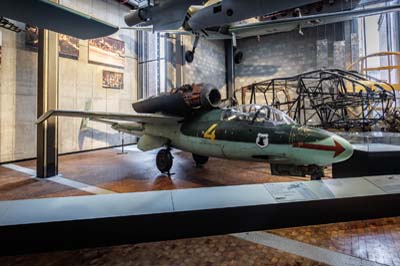
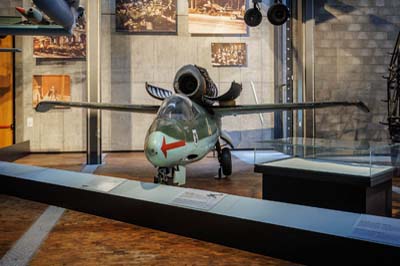
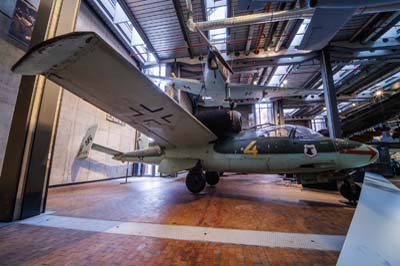
Left to right: Heinkel He 162A-2 Volksjäger (120076 'Yellow 4', VH523). The German aircraft industry were pushed towards the end of the war to produce aircraft designs that could reverse an ever increasingly desperate situation. The He-162 jet fighter took just 69 days from initial design to its first flight. It was the first aircraft to be fitted with an ejection seat. Deliveries began in February 1945, with 200 only being delivered. Due to a shortage of supplies it was mostly built of wood.
'Yellow 4' was captured at Leck, Nordfriesland, in Schleswig-Holstein, Germany. Designated RAF AM59, later VH523 at Farborough, it was to be shipped to Canada for the Canadian Aviation and Space Museum collection in Ottawa. It was traded to Aero Vintage in the UK for a Bristol Fighter (G-AANM, D-7889) in December 2006, before its move to Berlin in 2011. |
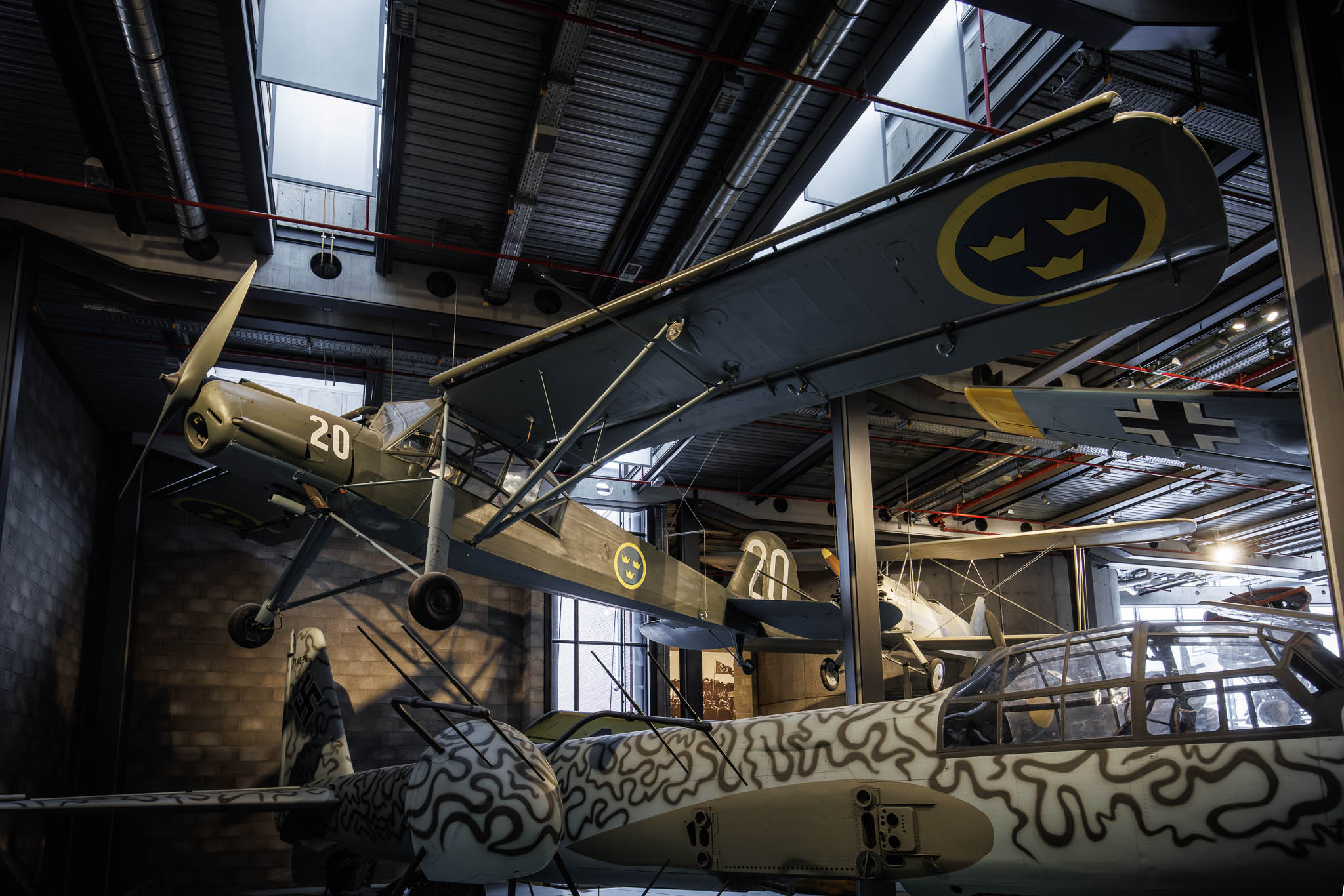 |
Left to right: Fieseler Fi.156C-3 Storch (Fv 3810 '20' registered D-ENTE) ex Swedish Air Force. Designed in 1935 the Storch was able to fulfil a variety of roles due to its incredible Short-Take-Off and Landing (STOL) capabilities. They were put into service between 1939 and 1945 as light transports and as air ambulances. 2,549 examples were built in Germany, Czechoslovakia by MRAZ and France by Morane-Saulnier at Puteaux.
The Swedish Air Force acquired 26 examples in three versions. With skis attached it could land on ice and snow and as such when stationed at Kiruna they were used to rescue refugees from German occupied Norway during the winter of 1944-45. Following their retirement in 1961 all remaining aircraft were sold in Germany and Austria.
D-ENTE was bought by the museum in 1982 after it had been damaged in a flying accident.
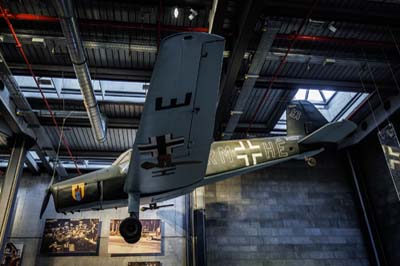
Bücker Bü 181 Bestmann (501659 'RM+HE', VN787). The prototype Bü 181 first flew in February 1939 and was later used by the Luftwaffe as a primary trainer. Most aircraft were built at the Bücker factory in Rangsdorf, with additional production by Fokker in the Netherlands, which produced 708 aircraft between 1942 and 1943. In Sweden, Hägglund & Söner AB built 125 examples for the Swedish Air Force, designated Sk 25. Further production took place at the Zlín plant in Czechoslovakia, which built 783 aircraft as the C.6 and C.106 for the Czech Air Force, as well as the civilian Zlín Z.281 and Z.381.
Of the more than 4,000 Bü 181s originally produced, only around ten examples survive today. This example was built in Czechoslavakia in 1944 and flew with the Air Cadets School at Kaufbeuren. Captured by the British it was taken to France. In 2010 it was acquired by the museum. |
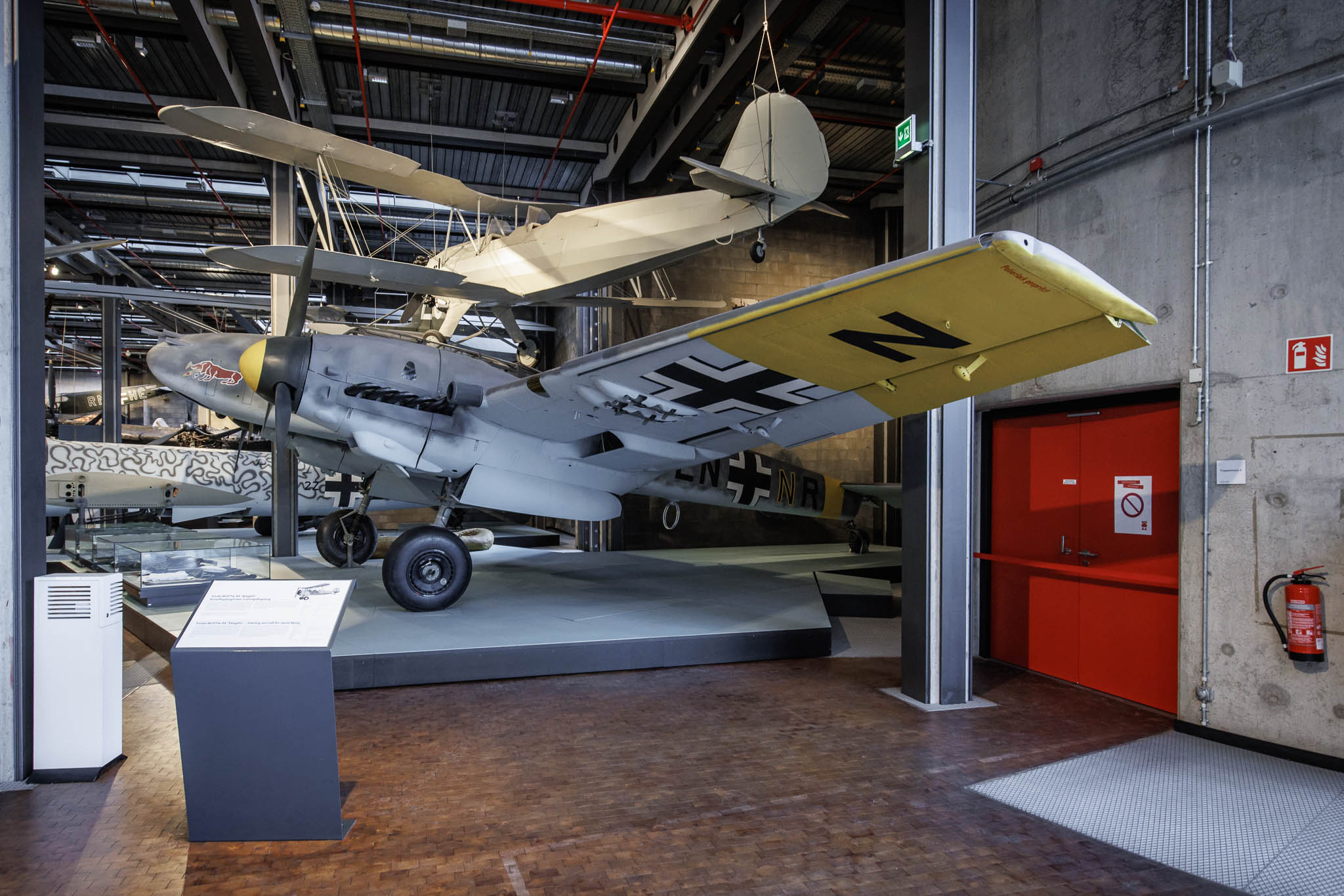 |
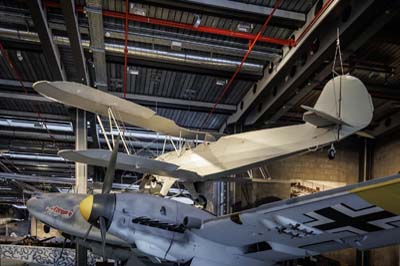
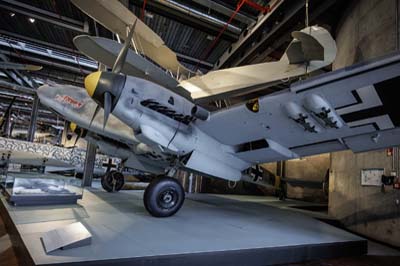
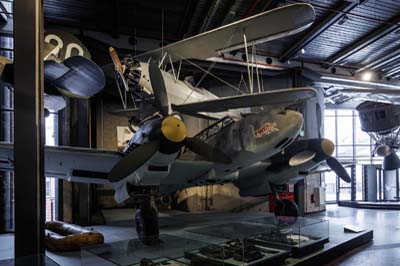
Left to right: Messerschmitt Bf 110F-2/trop (5052 'LN+NR'). The Messerschmitt Bf 110 was designed in 1939 as a long range escort fighter. With a crew of three, it could reach speeds of 342 mph (550 km/h). It first saw combat during the invasion of Poland in 1939. During the Battle of Britain, however, the aircraft proved vulnerable in daylight against the faster Spitfire and Hurricane. Later in the war it achieved considerable success as a night fighter.
The aircraft on display is a composite built from parts of Bf 110s 3235 and 4502. It represents a tropicalised variant intended for operations in hot climates such as North Africa and the Mediterranean. These aircraft were equipped with improved Daimler Benz DB 601F engines, additional armour, and sand filters, and served as long range destroyers and ground attack aircraft.
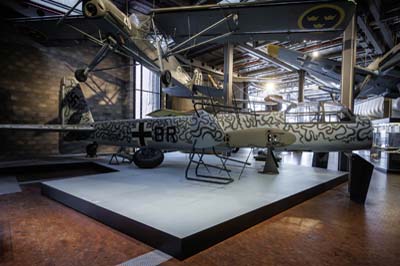
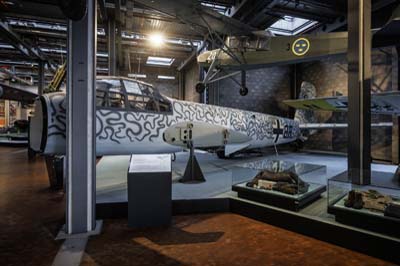
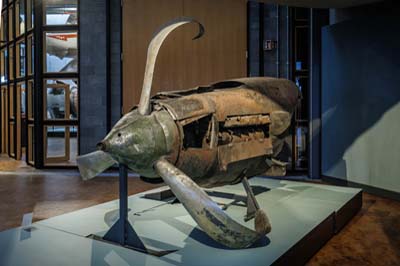
Junkers Ju 88G-1 (714628). The Ju 88 was one of the most versatile and successful German aircraft of World War Two. It served in a wide variety of roles including bomber, night fighter, and long range reconnaissance aircraft. The first Ju 88A aircraft were delivered in September 1939 and were quickly used in attacks on British shipping, later taking part in the Battle of Britain. However, their relatively weak defensive armament led to heavy losses in daylight operations, after which many were adapted for the night fighting role.
This aircraft was recovered from Lake Balaton, Hungary in the mid-1990s. It is the only Ju-88 night fighter variant. It carried an FuG 220 "Lichtenstein" nose radar and was powered by two BMW 801 engines. Partly restored it is painted as a night fighter of Reichsluftfahrtministerium (RLM) 76 light blue with RLM 75 grey violet squiggles. |
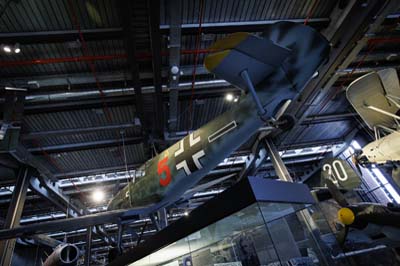
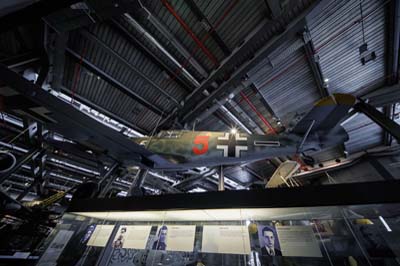
Left to right: Messerschmitt Bf 109E-3 (1407 'Red 5'). The Bf 109 was one of the finest single seat fighters from World War Two with 33,000 being produced. It was designed in 1935 and performed very well during the Spanish Civil War. It was only matched by the Spitfire's and Hurricane's performance. It could out climb both and was faster than the Hurricane but not the Spitfire. Its main limiting factor was its limited endurance as it could only engage in combat over England for a few minutes. A fighter-bomber version was introduced in 1940.
Bf 109 1407 was shot down in air combat on July 17, 1941 near Murmansk on the Kola Peninsula, but the pilot survived by making an emergency landing on a lake. The aircraft sank when the ice melted and remained submerged until it was salvaged in 1993. Examination revealed a 'Red 5' on the right fuselage and a 'Black 2' on the left, showing it served with multiple units. Initially registered as 'Red 5' with JG 77, it was damaged during a forced landing at Hiltra airfield near Trondheim, Norway, on October 27, 1940. After repairs, it returned to service as 'Black 2' with JG 77 until being shot down in 1941. The aircraft was later fully restored in Hungary.
Horten Ho IIL (D.10-125, USAF T2-7). This is a German tailless flying wing glider/motorglider designed by Reimar and Walter Horten in 1935. It was used for flight testing and served to test intake designs for later, more advanced jet-powered Horten aircraft, such as the Ho IX/Ho 229.
One of four built D.10-125 was captured by the Americans and numbered T2-7 and displayed at Freeman Field in 1945. It is the only survivor. |
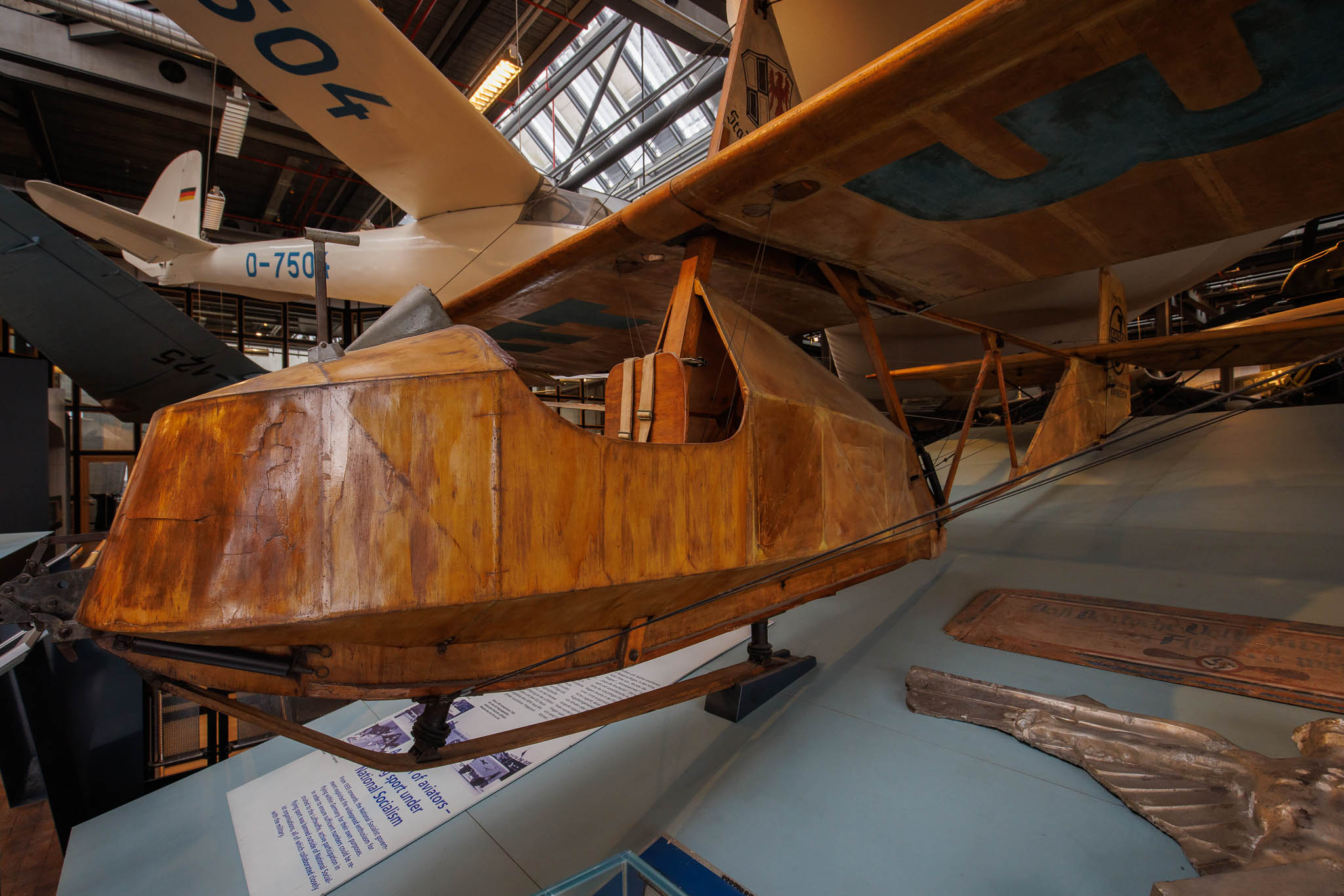 |
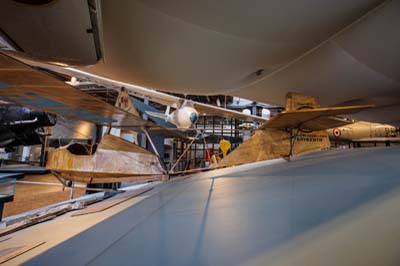
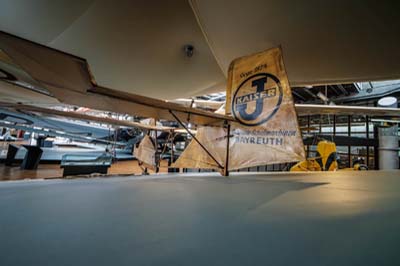
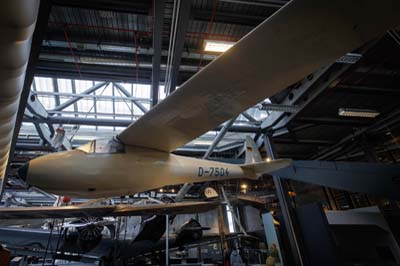
Left to right: SG 38 Schulgleiter (-). The SG 38 training glider was designed by Schneider, Rehberg and Hofmann at Schneider Flugzeugbau in Grunau in 1938. It became one of the most widely used aircraft for solo flight training in the 1940s. Development had begun in 1936, and from 1938 the glider was produced in large numbers by both amateur builders and industrial manufacturers, including the Deutsche Forschungsanstalt für Segelflug (DFS).
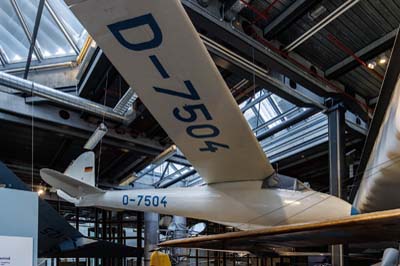
DFS Meise 51 (D-7504) was designed by the Deutsche Forschungsanstalt für Segelflug (DFS).
|
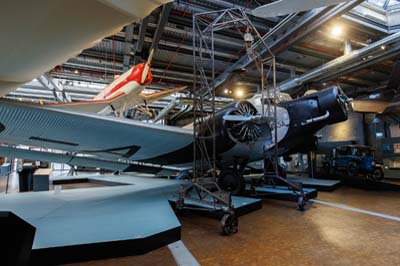
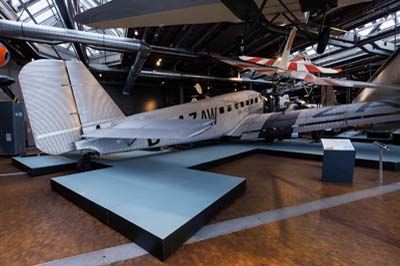
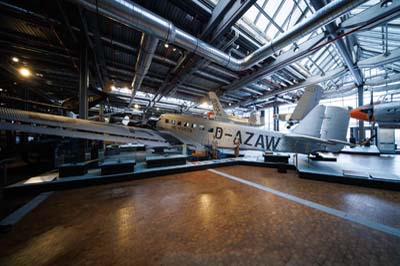
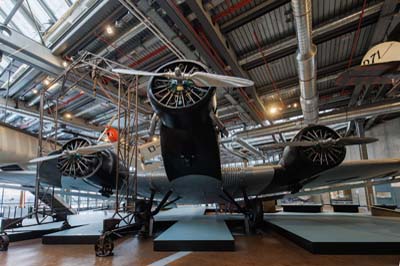
| Left to right: Junkers Ju 52/3mte (WNr. 7220 'CJ+KA', T.2B-108 registered D-AZAW, EC-CAK, EC-ABE). Built at the Junkers plant in Bernburg in 1941, the aircraft was delivered to Lufthansa the same year as D-AZAW "Hans Kirschstein." It was used on transport flights between Berlin and Spanish volunteer units serving on the Eastern Front. The aircraft later flew with Iberia and the Spanish Air Force. It was eventually restored by Lufthansa and is now displayed at the Deutsches Technikmuseum. |
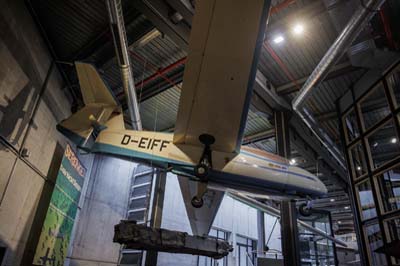
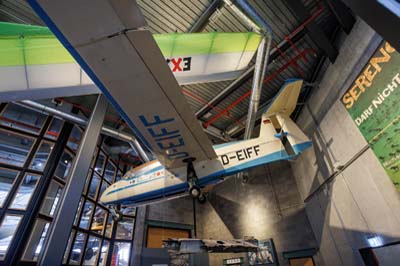
| Left to right: Rhein Flugzeugbau RW 3 Multoplan (D-EIFF). It was produced in small numbers by Rhein Flugzeugbau GmbH between 1958 and 1961. |
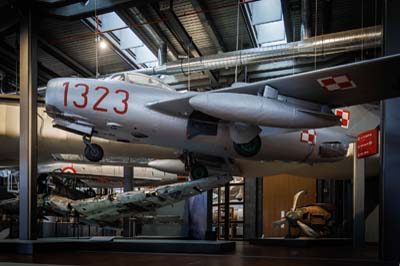
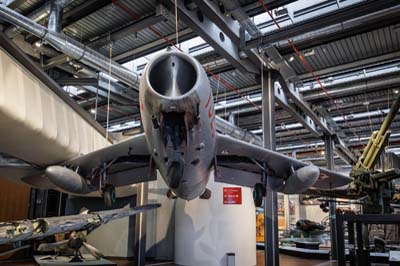
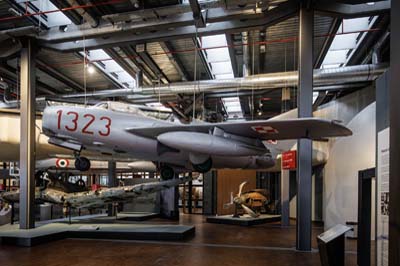
Left to right: PZL-Mielec Lim-2 (1323) ex Polish Air Force.
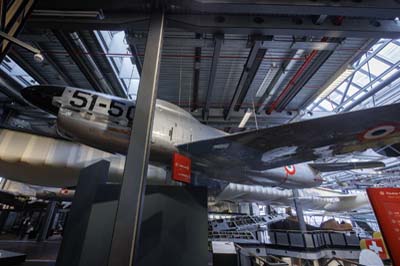
North American F-86K Sabre (MM55-4815 '51-50' it is fitted with tail of MM54-1256). The Italian Air Force (Aeronautica Militare - AMI) operated the Fiat-built F-86K Sabre as an all-weather interceptor, with units including the 51° Stormo (51st Wing) at Istrana-Treviso transitioning to the type in the mid-1950s. The F-86K was primarily phased out by the AMI in the late 1960s, with many being replaced by the F-104 Starfighter. |
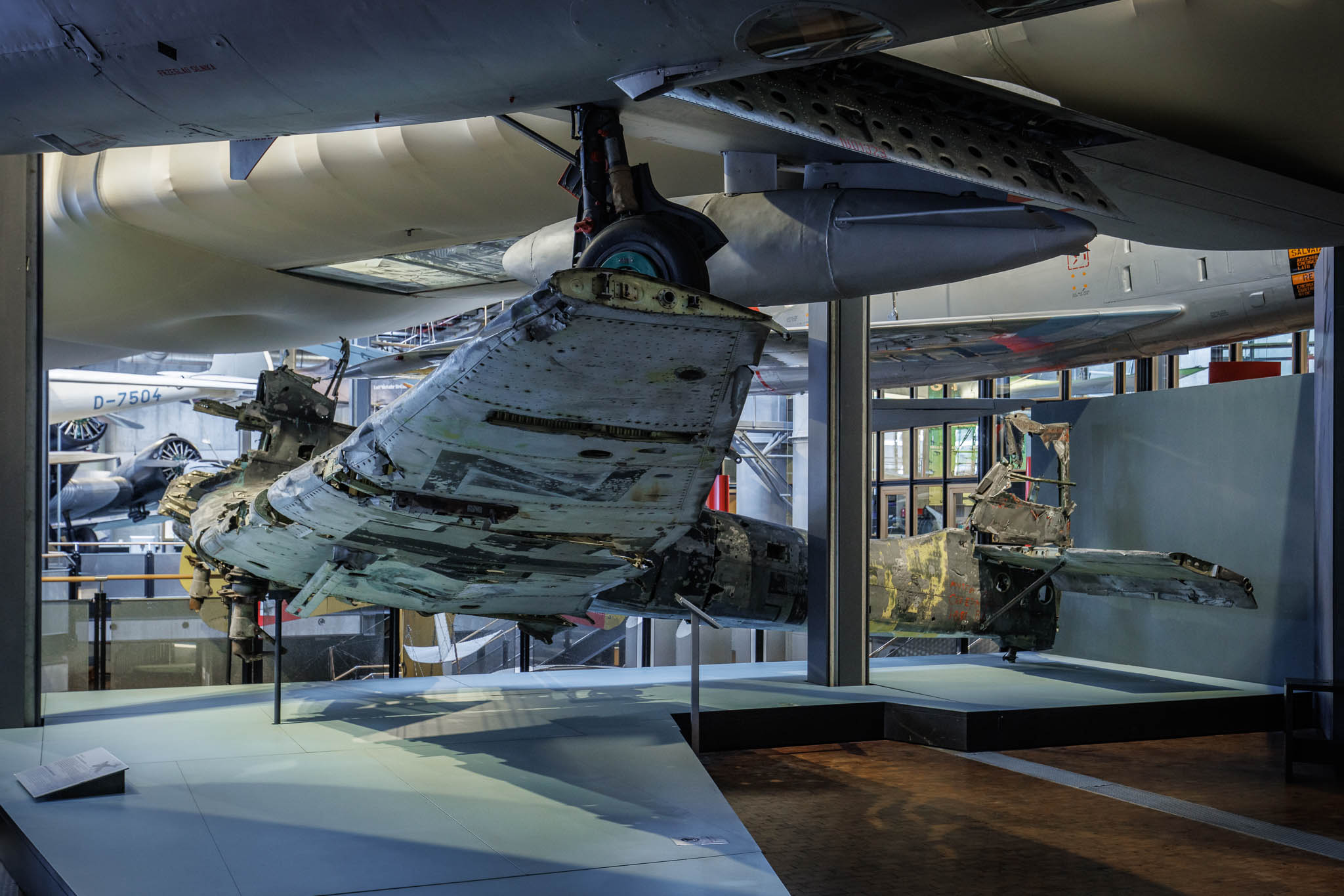
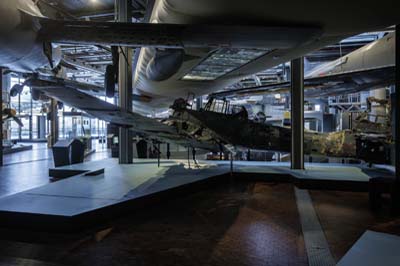
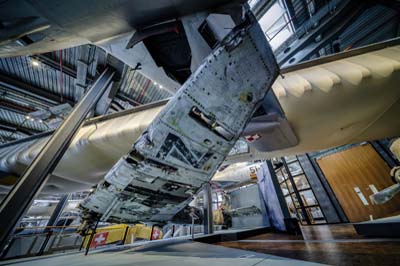
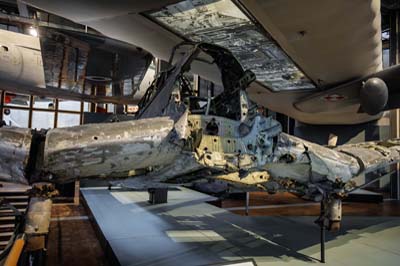
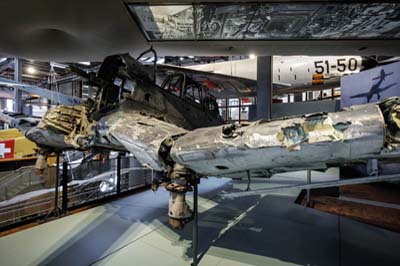
Left to right: Junkers Ju 87R-2 (5856 'L1+BL'). This aircraft belonged to Sturzkampfgeschwader 5 (St.G.5), a Luftwaffe dive bomber wing operating on the Northern Front in Norway, Finland, and the Arctic regions of Russia. On July 2, 1942 it made an emergency landing in Soviet territory following an attack on the railway line between Murmansk and Leningrad.
The wreck was discovered in 1994. After recovery it was first taken to England and, in 1995, sold to New Zealand. The Deutsches Technikmuseum acquired the aircraft in 1997. |
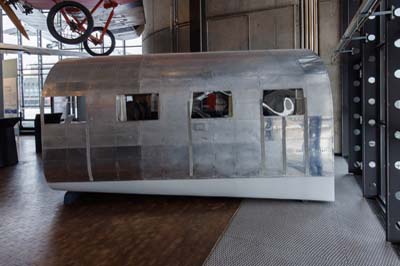
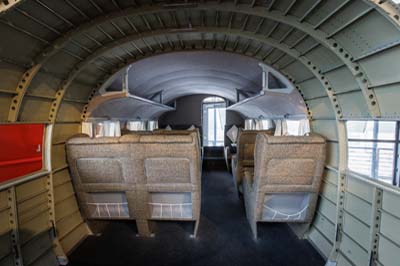
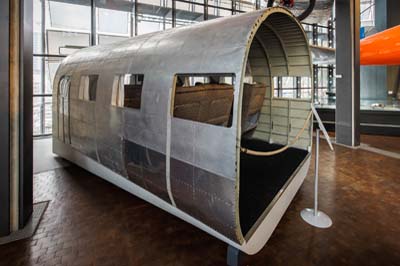
Left to right: Focke-Wulf Fw 200C-3 Condor (unknown). Initially conceived by Focke-Wulf's chief designer Kurt Tank as a modern four-engine, long-range airliner, the Fw 200 Condor was designed for comfortable, non-stop transatlantic travel. In August 1938, the specially prepared Fw 200 S-1 named Brandenburg flew from Berlin to New York in 24 hours 56 minutes, setting a record. Later that year, another Condor completed the Berlin to Tokyo flight in just over 46 hours, demonstrating its remarkable range.
During World War Two, the Condor was adapted for military service with the Luftwaffe, notably KG 40. Operating over the Atlantic, it conducted long-range reconnaissance and anti-shipping strikes, locating Allied convoys and coordinating attacks with German U-boats.
Despite its effectiveness, the Fw 200 proved vulnerable. Designed originally as a civilian airliner, the airframe struggled with the stresses of combat operations and heavy loads, leading to structural weaknesses and high losses. Later variants improved defensive armament and added radar, while many aircraft were reassigned to transport roles, including supply missions.
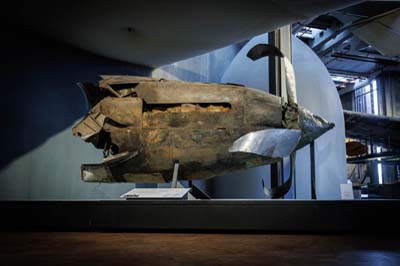
The C-3 variant was structurally strengthened, and fitted with Bramo 323 R-2 radial engines. The stress-skinned cabin exhibit had been used as a garage near Leipzig. |
Left to right: Ilyushin Il-2m3 "Shturmovik" (7945). Known as the "flying tank," the Il-2m3 was a heavily armored two-seat ground-attack aircraft used by the Soviet Air Force. After being recovered in 1993, it arrived at the museum on September 29, 1999.
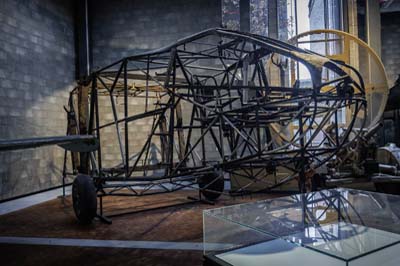
Gotha Go.242C-1 (unknown). Part frame of the transport glider only. Recovered in 1994 from a forest in Ribnitz-Damgarten in northern Germany and restored in Hungary.
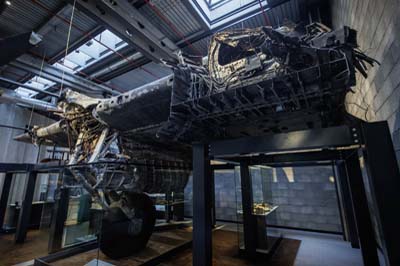
Avro Lancaster B3 Serving with 57 Squadron RAF, it was lost during a mission to Berlin on September 4, 1943, after being intercepted and shot down by a German night fighter. In September 1997, the wreckage was recovered from Großer Wünsdorfer See, Zossen, Brandenburg. |