de l'Amicale Jean-Baptiste Salis Air Meeting
Cerny airfield - La Ferté-Alais
May 26-27, 2007
|
 The Association Jean-Baptiste Salis (AJBS) held its 35th air meeting at the tree lined Cerny airfield at La Ferté-Alais. The disappointing weather on both days did noting to dampen the enthusiasm of the thousands spectators that lined the full length of the grass landing strip.
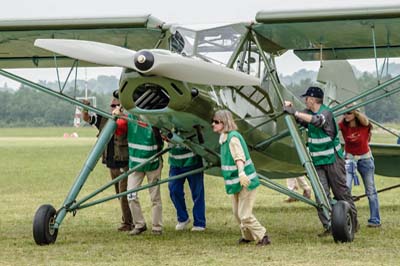
For the start of the event, the weather was not best suited for flying for such old and delicate aircraft, as the elevated airfield on its plateau was shrouded in swirling cloud. A number of aircraft were unable to display, but did the next best thing and taxied up and down the length of the airfield. The grey lifeless skies did not offer much to the numerous photographers along the length of the crowd-line.
Situated 30 miles (50Km) south of Paris, the airfield of La Ferté-Alais was built upon a plateau by one of France's most famous aviators, Jean-Baptiste Salis. Each year the show consists of a few solo displays combined with a number of multiple aircraft demonstrations in aviation themes.
For a more complete history of Jean-Baptiste Salis his son Jean and their aircraft please visit their excellent website. |
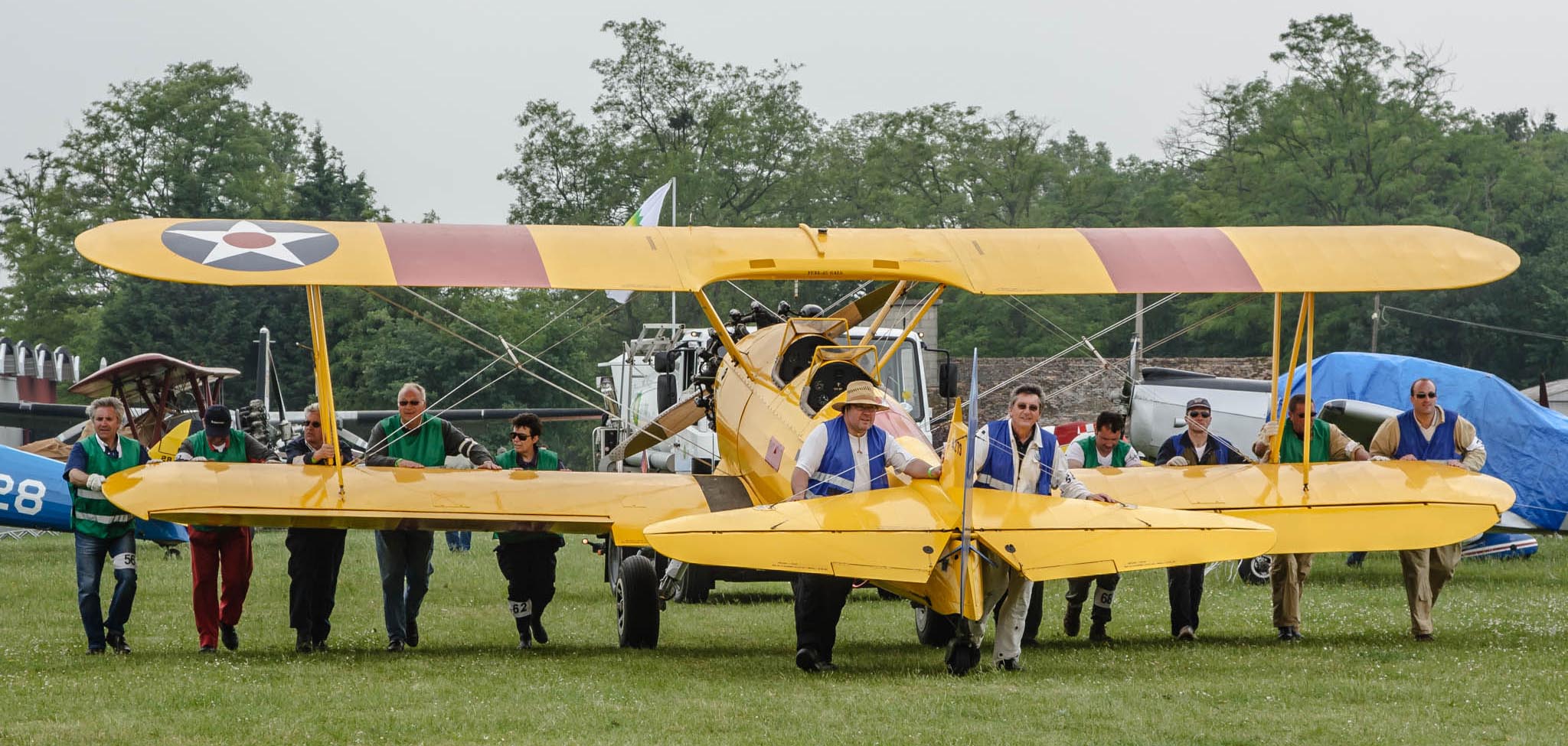 |
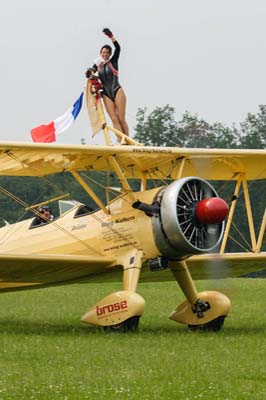
| La Ferté-Alais based Boeing PT-13 Cadet (PT-17 Stearman) F-AZMZ |
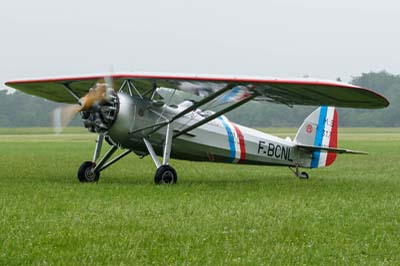
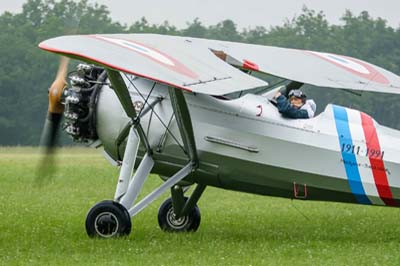
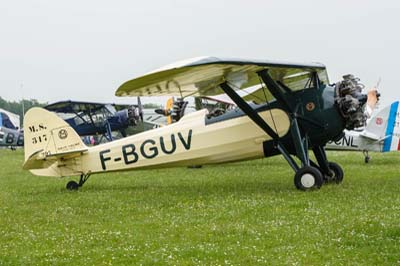
| Left to right: Morane-Saulnier MS.317s (F-BCNL/6527 and F-BGUV/297). The MS.301 first flew in 1931 and from 1960 40 MS.315s were upgraded to MS.317 for the French Navy. |
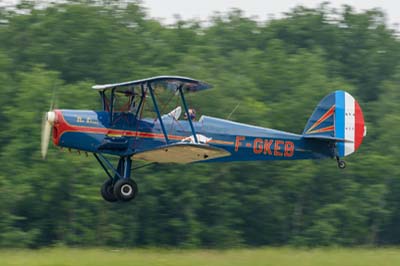
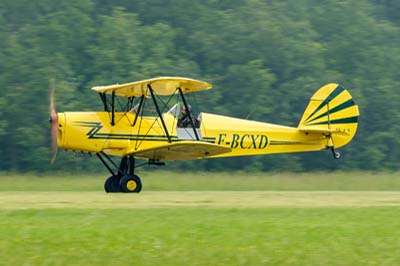
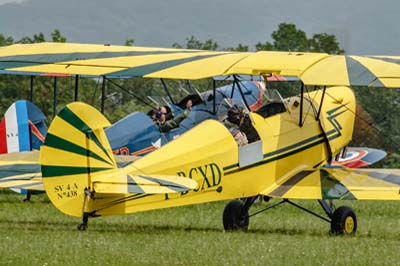
| Left to right: Stampe-Vertongen SV.4As (F-GKEB c/n 618 and F-BCXD c/n 438). |
Left to right: Nord 3202 (F-AZIY No.15), designed as a basic trainer for the ALAT to replace the Stampe-Vertongen SV.4 it first flew in 1957. 'ZIY' has been with AJBS since 1979, where it was stored until its restoration from 1989 to completion in 1994
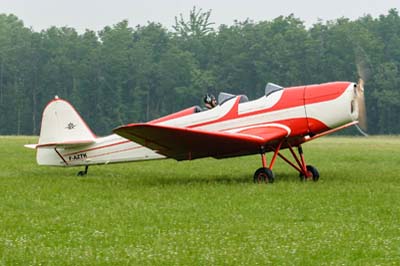
Klemm Kl 35D (Fv5020 registered F-AZTK) ex Swedish Air Force (Sk 15A) built in 1940. The Klemm Kl 35 was a German sporting and training aircraft developed as the successor to the Kl 25 by Klemm Leichtflugzeugbau GmbH. Retaining the single engine, cantilever low wing layout of its predecessor, it introduced a distinctive inverted gull wing that set it apart visually and aerodynamically.
First displayed publicly at the International Air Show in Milan in October 1935, the Kl 35 was fully aerobatic. Development suffered an early setback when the prototype crashed during testing at Rechlin in 1935, but subsequent trials proved successful. In July 1936, an initial order for 23 aircraft was placed, with production increasing steadily. At the time, Klemm was also building the Focke Wulf Fw 44 under licence.
An improved version, the Kl 35D, appeared in 1938 as a Luftwaffe trainer. Powered by a 105 horsepower Hirth HM 504A 2 engine and capable of operating on wheels, skis, or floats, it was used extensively to train student pilots in aerobatics, navigation, and transition to faster military aircraft. Though not a combat aircraft, it played a vital role in preparing thousands of Luftwaffe pilots.
The Kl 35 became the most numerous Klemm design, with more than 3,000 built. The Swedish Air Force acquired several, designated Sk 15, including seaplane variants, and began licence production in 1941, building about 74 additional aircraft. Some remained in Swedish service until 1951. Today, only around 12 Kl 35s survive, most of them in Germany or Sweden.
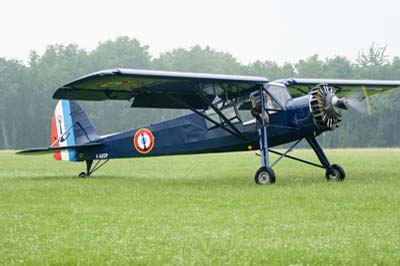
Morane-Saulnier MS.502 Criquet (F-AZCP) which is based at La Ferté-Alais. |
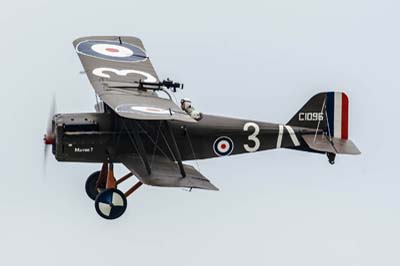
| Left to right: Royal Aircraft Factory SE.5 Replica's (C1096 '3' and F-AZCY 'A8898') which were built for a french movie. |
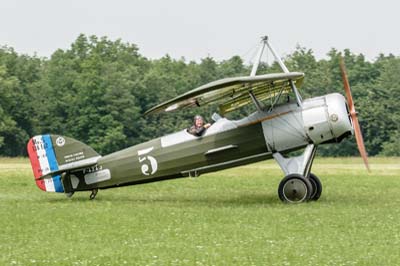
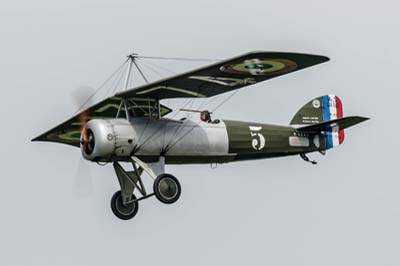
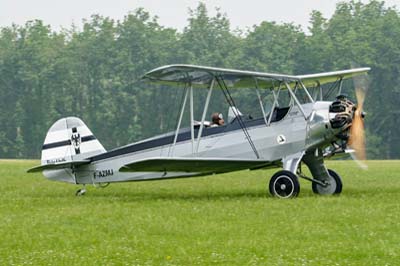
Left to right: Morane-Saulnier MS.138 (F-AZAJ '5')
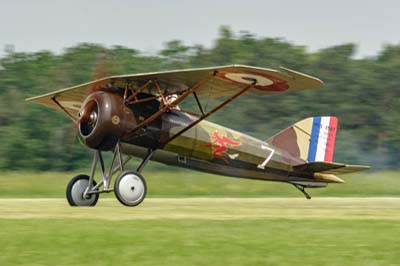
Morane-Saulnier type A1 (F-AZAP/1567 '7') it was re-built from an original in 1947 by AJBS. |
Left to right: Focke-Wulf Fw 44J Stieglitz (F-AZMJ).
Bücker Bü 131 Jungmann (F-AZTT), Former Swiss Air Force.
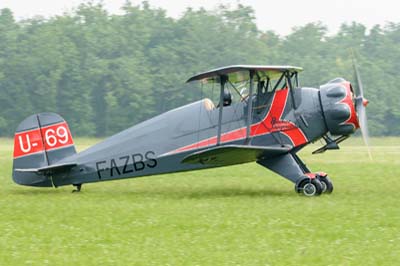
Bücker Bü 133C Jungmeister (U-69 registered F-AZBS).
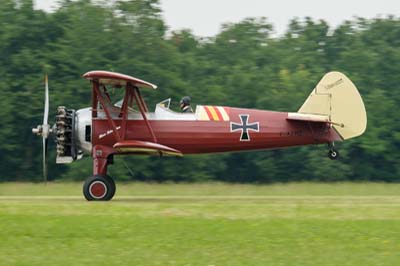
Boeing Stearman PT-17 (F-AZMZ) it was painted in German markings for a film. |
| World War Two and the Battle of Britain |
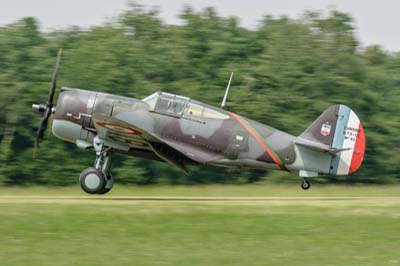
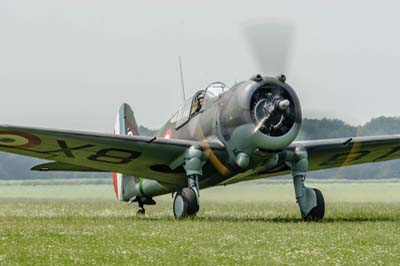
Left to right: Curtis H-75-C1 Hawk (No.82 'X8-81').
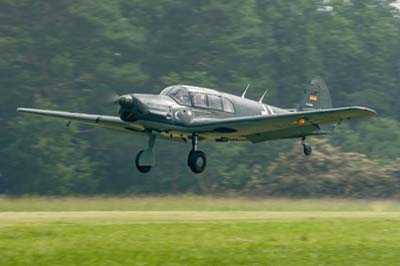
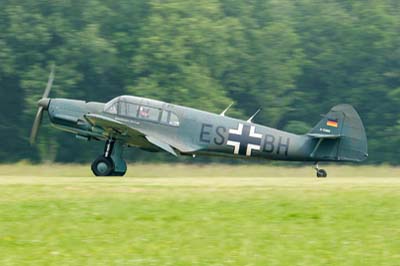
Messerschmitt Bf 108B1 Taifun (D-ESBH 'ES+BH'). |
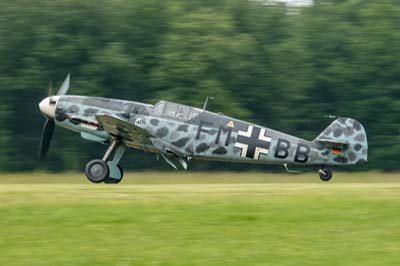
Left to right: Messerschmitt Bf 109 (D-FMBB 'FM+BB')
Spitfire Mk.5 (EP120 'AE-A' also G-LFVB) from the Fighter Collection at Duxford.
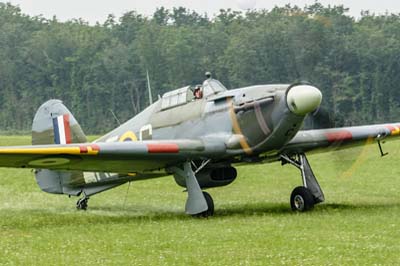
Hurricane XIIB (BD707 'AE-C' also G-HURR formally RCAF 5589) from the Real Aircraft Company. Sadly G-HURR crashed killing the pilot, Brian Brown on September 15, 2007 during a Battle of Britain display at Shoreham.
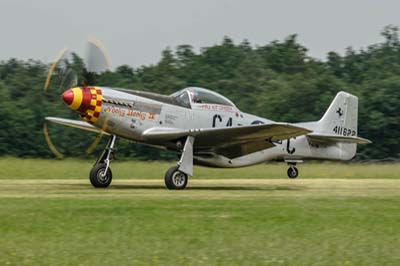
North American P-51D Mustang (F-AZSB / 411622 'G4-C') 'Nooky Booky IV' which is based at La Ferté-Alais after arriving in France in 1998. |
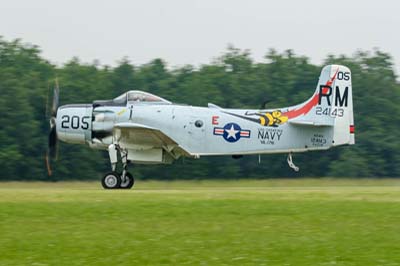
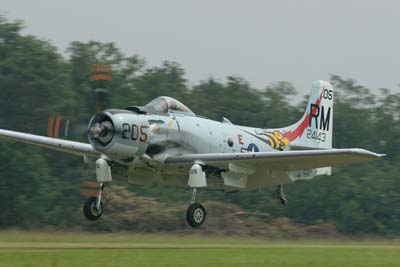
Left to right: Ex French and later Gabon Air Force Douglas AD-4N Skyraider (F-AZDP / 124143 'RM-205'), it was bought by AJBS in 1984.
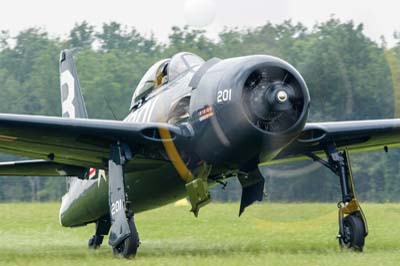
Grumman F-8F Bearcat (G-RUMM / 121714 'B-201').
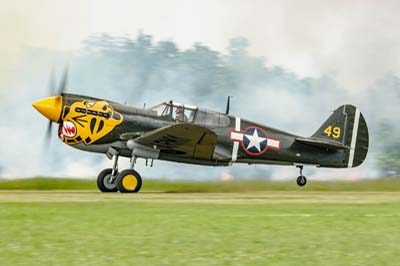
Curtis P-40M Kittyhawk (G-KITT) based at Duxford takes-off through the impressive pyrotechnic display.
|
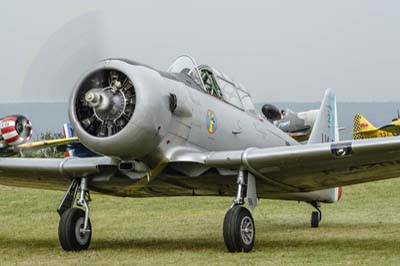
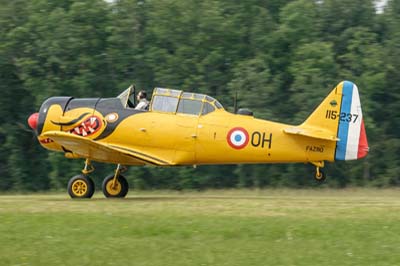
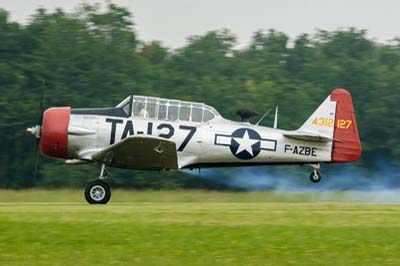
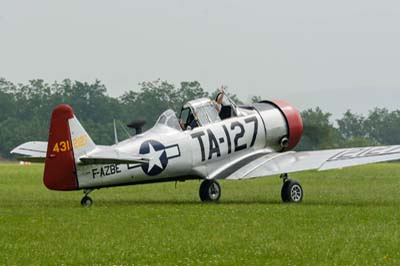
In the mid-1970s La Ferté-Alais was responsible for recovering and restoring a number of AT-6 Texans,
many of then return each year for the show. |
| Left to right: North American AT-6 Texans (F-AZRD/51-14906 'RD', F-AZBQ/51-15237 'OH' and F-AZBE/43-12127 'TA-127'). |
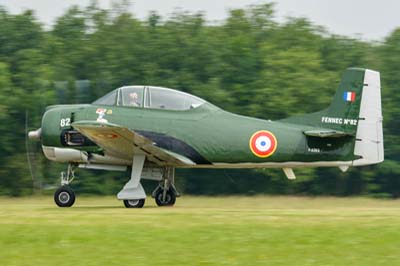
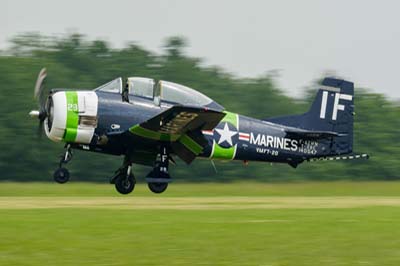
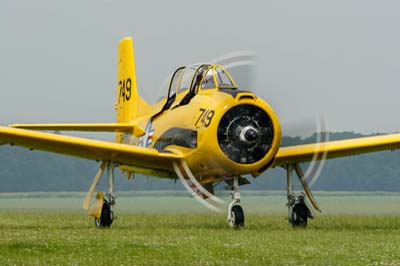
Left to right: North American T-28 Fennec/Trojans (T-28S F-AZKG No.82 with AJBS, T-28C F-AZHN/140547 'IF-28' and T-28 F-AZHR/517749).
|
The Photography
La Ferté-Alais welcomes visitors all year round; the Pentecost show is the main activity of the year when most of the extensive collection is flown. Accessed by a now widened winding road to the top of the L'Ardenet plateau, the airfield is a place of beauty.
 It is still surrounded by vast wooded areas and it's wide grass runway is roughly east to west. The runway long crowd line is positioned close to the action on the south side. With the sun behind you and the close proximity of the aircraft, photography is very good. The display aircraft are mostly positioned south side at the eastern end by the hangars and museum in a series of well-spaced rows. The clever bit here is that spectators are free to roam up avenues in between the aircraft rows to get those close in shots. Even the aircraft parked across the other side of the access way to the runway are within easy reach of small telephoto lenses.
The flying is close but can appear a little tame at times, as many of the classic aircraft are not all high performance warbirds. This is what I like however, being able to photograph mostly French civilian and ex military aircraft in their element, flying from one of the most attractive grass airfields there is.
I found that a 100-400mm zoom lens more than adequate for the flying shots. As 99% of the action involves propellers it is important to keep the shutter speeds low 1/60th to 1/125th is what I used for this show. I have added my settings to some of the image captions for guidance. You must be prepared to bin quite a few shots using these slow shutter speeds as it is difficult to pan perfectly (well for me it is!) each time. The resulting blurred background emphasizes speed very nicely.
Last year I noted that running down the length of the crowd line there was a red and white tape a meter high which obstructed shots of the aircraft. I am pleased to report that for this year it had been reduced to just a few inches high, well done to the orgainsers.
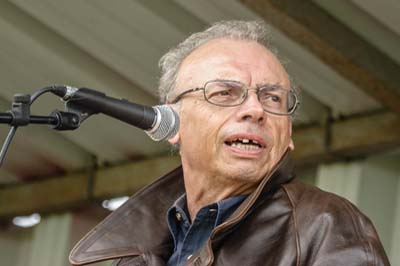
(left); The very eloquent french commentator who speaks in a flying poetry.
For most of the show I was using my Canon EOS 20D and EF 100-400mm f4/5.6 L IS lens. |
 |