
|
|
|
|
| Base31 Picton, Ontario October 2026 |
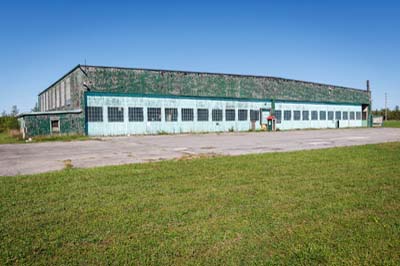
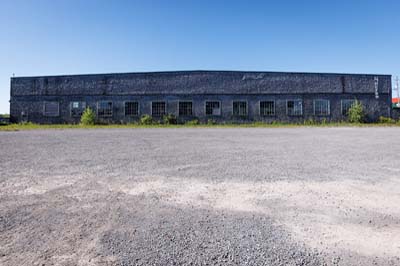
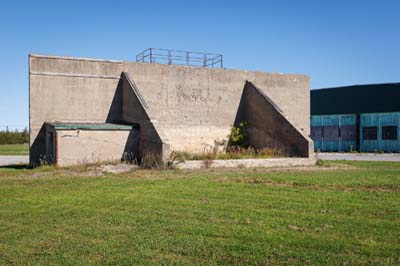
| Base31 is located on the former CFB Picton airfield which operated from World War Two until 1969, serving the Royal Air Force (RAF), Royal Canadian Air Force (RCAF) and Canadian Army. Established under the British Commonwealth Air Training Plan (BCATP), the site was first occupied by No.1A Manning Depot in November 1940 as a temporary measure, ahead of the arrival of No.31 Bombing and Gunnery School, which officially opened in April 1941. An airfield was constructed on a high plateau overlooking Picton, alongside five bombing ranges. Training aircraft included the Avro Anson, Fairey Battle, Bristol Bolingbroke and Westland Lysander. The school delivered six-week courses in bombing, navigation and air gunnery until it closed in November 1944. The RCAF subsequently established No.5 Reserve Equipment Maintenance Unit, responsible for aircraft storage and airfield maintenance. It operated until January 1946, when its duties were transferred to RCAF Station Trenton. Today, the site has been transformed into 'Base31', a concert venue and cultural destination. Six large hangars built for the British Commonwealth Air Training Plan survive, distinguished by their wooden roofs supported by steel buttresses. According to local accounts, the steel was originally intended for Trenton but was delivered to Picton instead. |
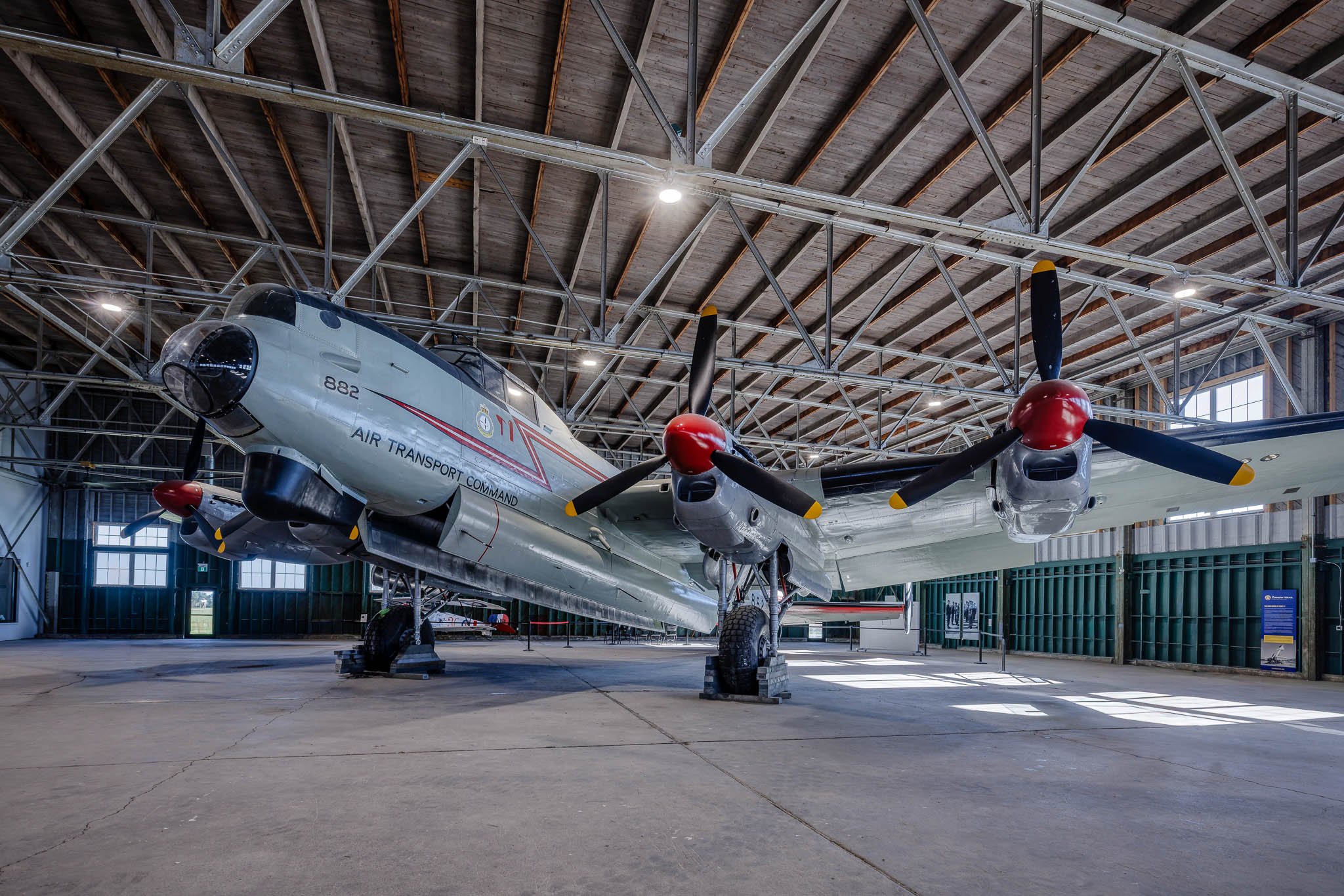 |
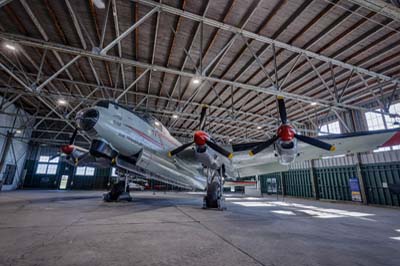
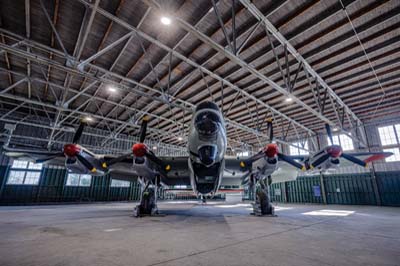
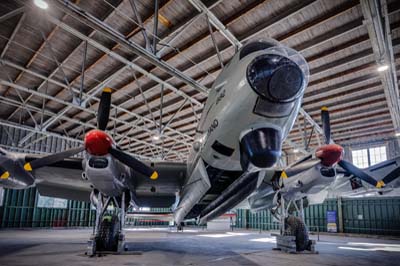
| Avro Lancaster Mk.10AR (KB882 '882') is on loan courtesy of the "National Air Force Museum of Canada" till 2029, five years after it arrived here.
The four-engine Avro Lancaster entered operational service in 1942 and became one of the principal heavy bombers of World War Two. Capable of carrying the 12,000 lb Tallboy and 22,000 lb Grand Slam bombs, it was flown by thousands of Canadian airmen in RAF and RCAF squadrons. By 1944, No.6 Group, Bomber Command's Canadian formation, operated 13 Lancaster squadrons. Lancaster KB882 was built by Victory Aircraft Ltd in Malton, Ontario, in November 1944, one of 430 Mk.10 aircraft manufactured in Canada. Delivered to England in March 1945, it joined No.428 "Ghost" Squadron and flew eleven combat missions before hostilities ended in Europe. Returned to Canada in June 1945 for possible service with "Tiger Force" in the Pacific, it was instead placed in storage at MacLeod, Alberta, following the end of the war. In 1956, KB882 was extensively modified into a Mk.10AR (Area Reconnaissance) aircraft and assigned to No.408 "Goose" Squadron at RCAF Station Rockcliffe, Ontario. A 40-inch extension ahead of the cockpit accommodated additional camera and radar equipment. Over the next eight years, it carried out photographic mapping, intelligence gathering and reconnaissance missions, including surveillance of Soviet ice stations. Struck off strength in 1964, KB882 was acquired by the City of Edmundston, New Brunswick, for static display at the local airport. Donated to the National Air Force Museum of Canada in 2017, it was dismantled and transported to Trenton for restoration, with support from military and civilian personnel. External restoration was completed in 2024, and the Lancaster moved to Base31 in Picton, Ontario, for temporary display while the museum plans an expansion to house it. |
 |
 |
 |
 |
 |
 |
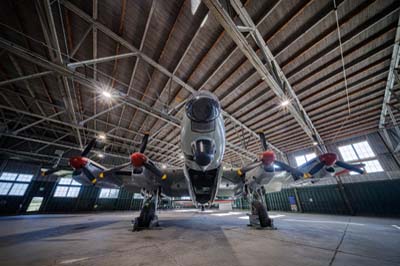 |
| Avro Lancaster Mk.10AR (KB882 '882'). |
 |
 |
 |
| The six surviving hangars, labelled H1 to H6, are being repurposed as cultural, event and museum spaces. Left: Hangar 1 (H1) houses the main Exhibition Hall in a beautifully restored World War Two aircraft hangar, featuring immersive storytelling and historical artefacts. The British Commonwealth Air Training Plan (BCATP). The BCATP was one of the largest aviation training programmes of World War Two, training more than 130,000 Allied aircrew in Canada, principally from Canada, Great Britain, Australia and New Zealand. Canada offered vast open spaces, favourable flying conditions and, most importantly, distance from the fighting in Europe. The programme trained pilots, navigators, bomb aimers, wireless operators, air gunners and flight engineers, ultimately providing almost half of the aircrew who served with the RAF, Fleet Air Arm, RAAF, RCAF and RNZAF during the war. The agreement called for almost 50,000 aircrew to be trained each year, including 22,000 from Great Britain, 13,000 from Canada, 11,000 from Australia and 3,300 from New Zealand. Elementary training was normally completed in each aircrew member's home country before they travelled to Canada for advanced instruction. The first Canadian training course began on April 29, 1940, with 166 recruits. The programme expanded rapidly, with 701 hangars and 176 new locations constructed. Between 1940 and 1943, Canada built 88 primary and 88 relief airfields, while existing municipal and regional airfields were incorporated into a network of 231 training locations across the country. The BCATP ended on March 31, 1945. By then, 131,553 trainees, including 49,808 pilots, had graduated. The Canadian government contributed approximately $2 billion towards the programme's total cost of $2.25 billion, making the BCATP one of Canada's largest wartime undertakings. BCATP Hangars The 701 hangars constructed at 231 locations from the start of World War Two specifically for the programme were never intended to survive for 80 years. Nevertheless, remarkably, many still exist in one form or another. Their distinctive roofs and structural supports feature exceptionally long, heavy timber beams, meticulously milled from Douglas fir trees transported from British Columbia. With steel in short supply, builders used prefabricated wooden trusses and heavy timber frames instead. Construction crews could erect the complete wooden framework of a standard hangar in less than eight hours, while the exterior walls were clad in cedar wood shingles. |
 |