Smithsonian's National Postal Museum
Washington DC
October 2025
|
The Smithsonian's National Postal Museum is housed in the historic City Post Office Building, constructed in 1914, which served as Washington DC's main post office until 1986. The museum features an extensive collection of postage stamps, postal vehicles, and related equipment. Of particular interest to me of course is the 'Airmail in America' exhibition, which explores the 1920s and 1930s airmail contracts and the early development of the nation's commercial aviation industry.
From 1918 to 1926, the United States operated its first airmail service. Early on, the Post Office Department relied on the military for planes and pilots. On May 18, 1918, US Army aviators flew the inaugural route between Washington DC and New York City using Curtiss JH-4 'Jennies'. Later in 1918 the department received 100 de Havilland DH-4 planes from the US Army. Designed by Geoffrey de Havilland and built in England and the United States these planes saw little combat and were repurposed to carry mail across the country.
Unusually, the museum employs airport-style security, screening every visitor for sharp objects such as knives, screwdrivers, scissors, firearms, pepper spray, and mace. One unexpected challenge for me was that my tripod was also prohibited. It seems that carrying one gave the impression of a professional photographer. |
 |
 |
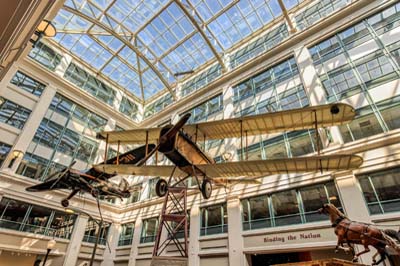 |
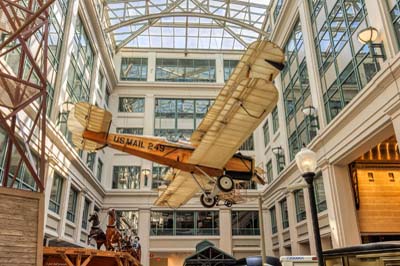
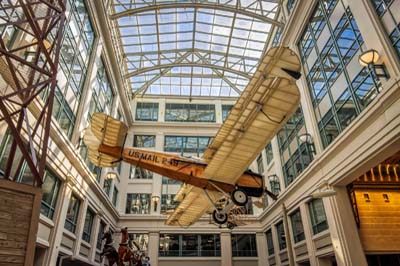
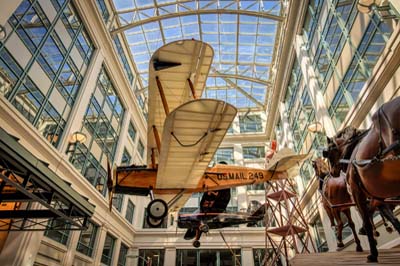
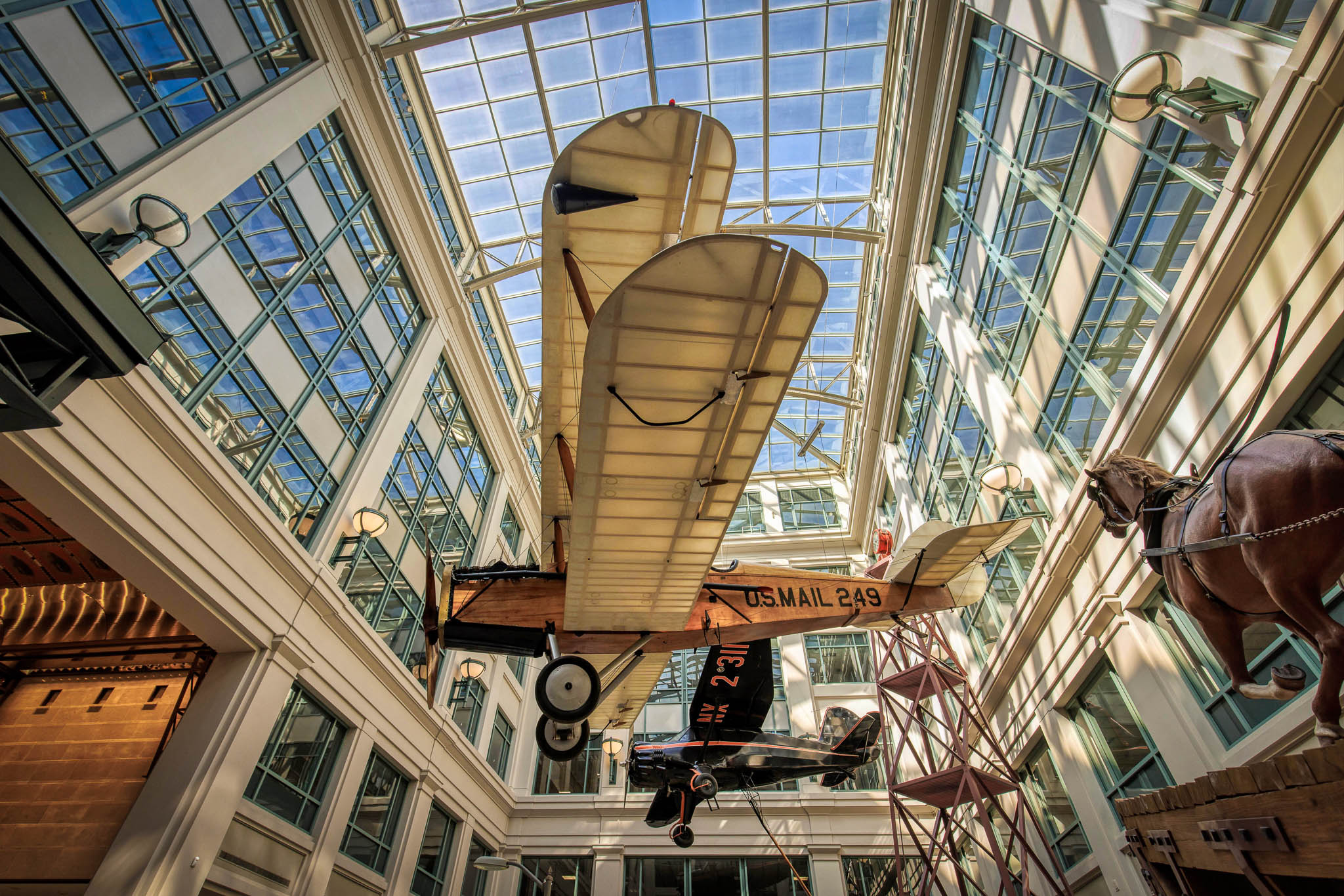
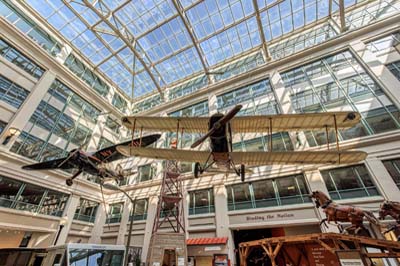
Left to right: de Havilland (Airco) DH-4B (N249B '249'). The Airco DH.4 was a British two-seat biplane bomber designed by Geoffrey de Havilland during World War One. Built for Airco, it became the first British light day bomber that could defend itself.
When the United States entered the war in 1917, it lacked combat-ready aircraft and selected the DH-4 for production due to its simple construction and suitability for mass manufacturing. American-built DH-4s were produced by Boeing, Dayton-Wright, Fisher Body, and Standard Aircraft Corporation and powered by a 400-horsepower Liberty V-12 engine. Of the 9,500 ordered, only 1,885 reached France before the end of the war. There, they served as bombers, observation aircraft, trainers, and utility planes, primarily with the Northern Bombing Group based in Dunkirk.
After the war, the US Post Office adapted surplus DH-4s for airmail service. Beginning in January 1919, major modifications improved safety—most notably moving the pilot's cockpit rearward. The upgraded aircraft were redesignated DH-4B, and 1,538 were converted between 1919 and 1923. The improvements proved highly effective; in their first year, DH-4Bs carried more than 775 million letters and became the backbone of early US airmail service until private companies took over in 1926.
The exhibited DH-4B (N249B '249') was involved in a crash on December 15, 1922, when a US Airmail pilot struck a 9,400-foot mountain while flying from Salt Lake City to Rock Springs, Wyoming. Despite the downdraft crash and sub-zero temperatures, the pilot survived and hiked 24 hours to safety. The aircraft was recovered 40 years later, restored for the National Air and Space Museum, and is now on loan to the Postal Museum. |
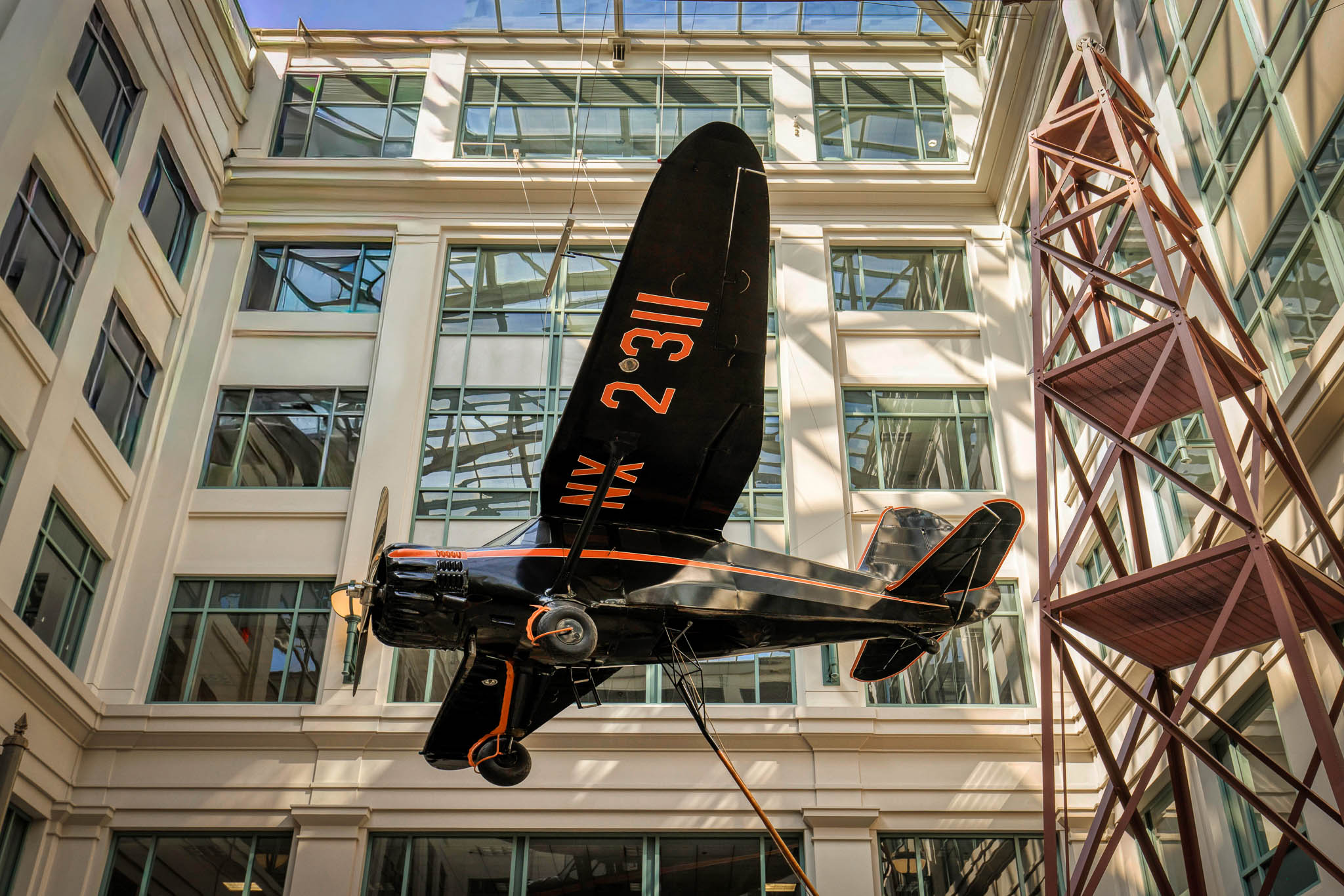 |
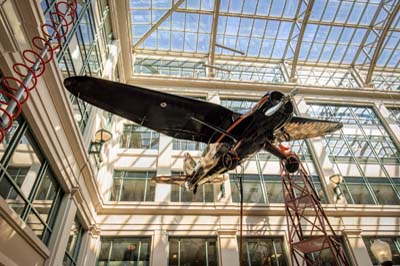
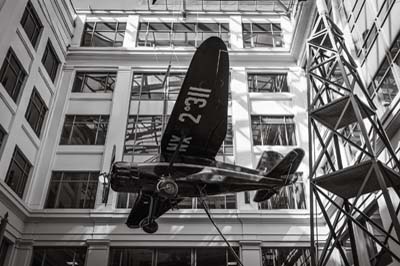
Left to right: Stinson SR-10F Reliant (NX2311). The Stinson Reliant is a high-wing, single-engine monoplane designed to seat four to five people, built by the Stinson Aircraft in Wayne, Michigan. Between 1933 and 1941, a total of 1,327 Reliants were produced across various models ranging from the SR-1 to the SR-10. The final commercial version, the SR-10, was launched in 1938. Production of the Reliant can be divided into two main categories: the straight-wing models (SR-1 through SR-6) and the gull-wing models (SR-7 through SR-10).
This aircraft was completed in July 1939 and is one of only 18 built of its model. In the early 1940s, it took part in airmail pick-up experiments conducted by All American Aviation, and in 1943 it was used by the United States Army Air Forces for experimental tests involving the rescue and recovery of gliders and individuals. On September 5, 1943, Captain Norman Rintoul, a former All American pilot, successfully flew this aircraft in the first-ever pick-up of a person from the ground.
After the experiments concluded, the Army declared the aircraft surplus in 1945. It was subsequently purchased by All American Aviation and later by Rintoul, who flew it on the air show circuit to demonstrate human pick-ups. In 1949, the aircraft was donated to the National Air Museum. Following a restoration in 1993, it has been on loan to the Smithsonian National Postal Museum in Washington DC.
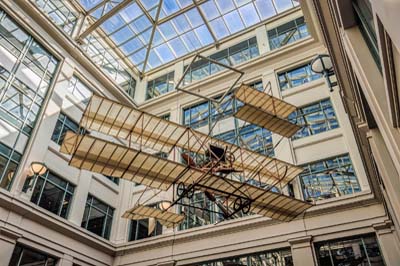
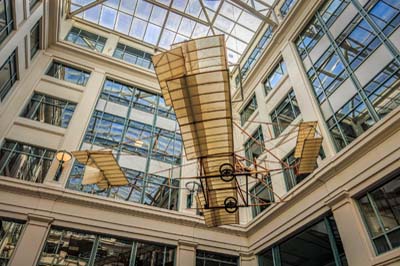
Wiseman-Cooke Fred Wiseman, a race-car driver from Santa Rosa, began building an airplane in 1909 using ideas from leading aircraft makers. It became the first airplane built in California to fly, with successful tests in spring 1910. While it was being tested, he started building a second aircraft, which he later used for all major exhibition flights, including the first officially sanctioned US air mail flight, from Petaluma to Santa Rosa in February 1911.
|
 |